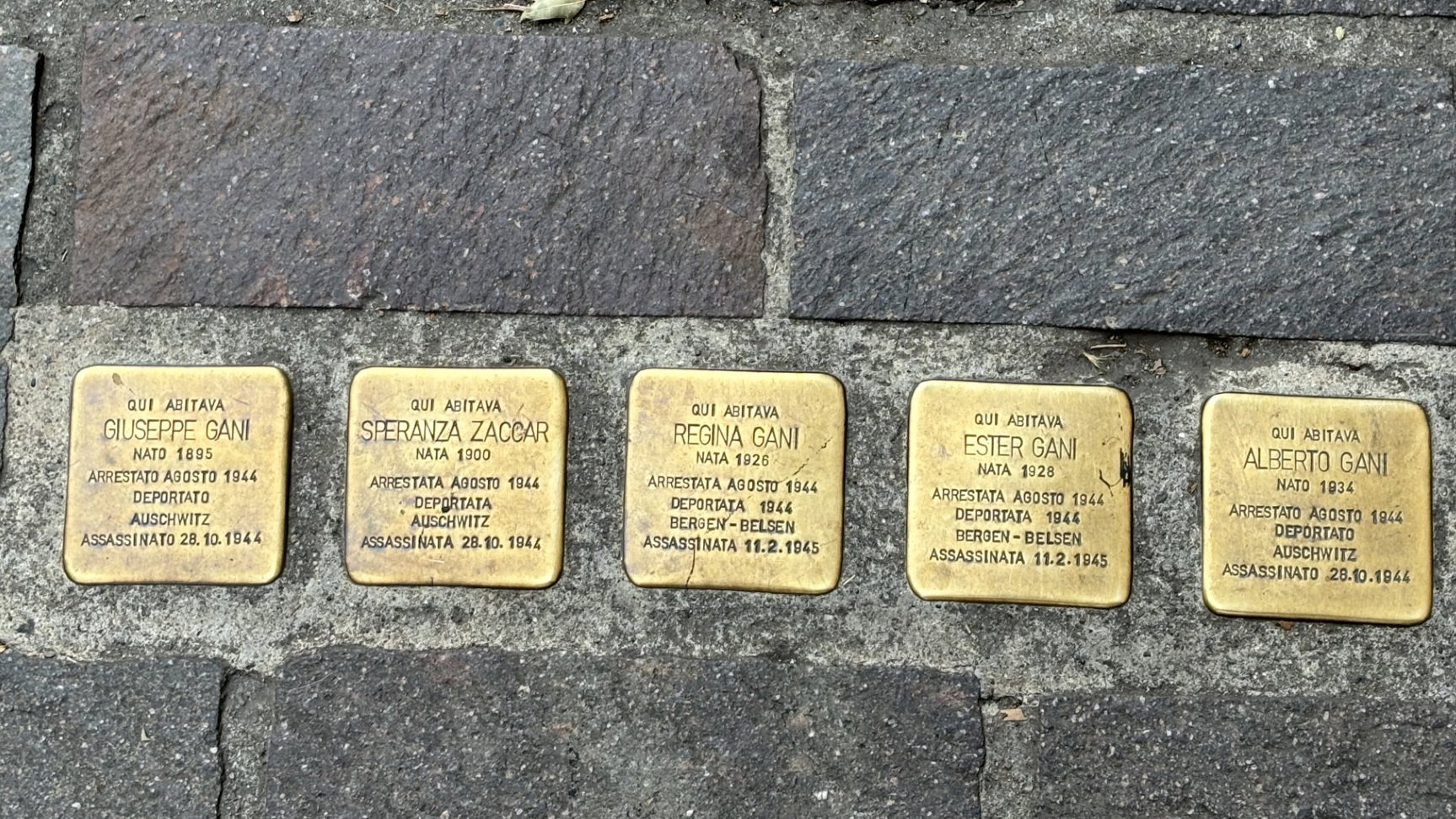
The Stolpersteine of Seregno - Part 1
I recently moved from Monza to the smaller neighbouring city of Seregno. Having looked at many of the hundred or so Stolperstein in Milan , (Holocaust memorial Day 2021- The Stolpersteine of Milan, On the Shares of lago Maggiore . The murders at Meina, A Walk Around the Stolpersteine of Milan ) I have found that there are also some here as well.
commemorating those deported to camps during the Nazi occupation of Northern Italy. As in most Italian cities the stones commemorate both Jewish residents deported to Nazi camps and Italian political prisoners and interned military personnel deported to labour camps and who never returned.In part one , we start with the stones commemorating five members of one Jewish family resident in Seregno who were deported to and murdered at Auschwitz .
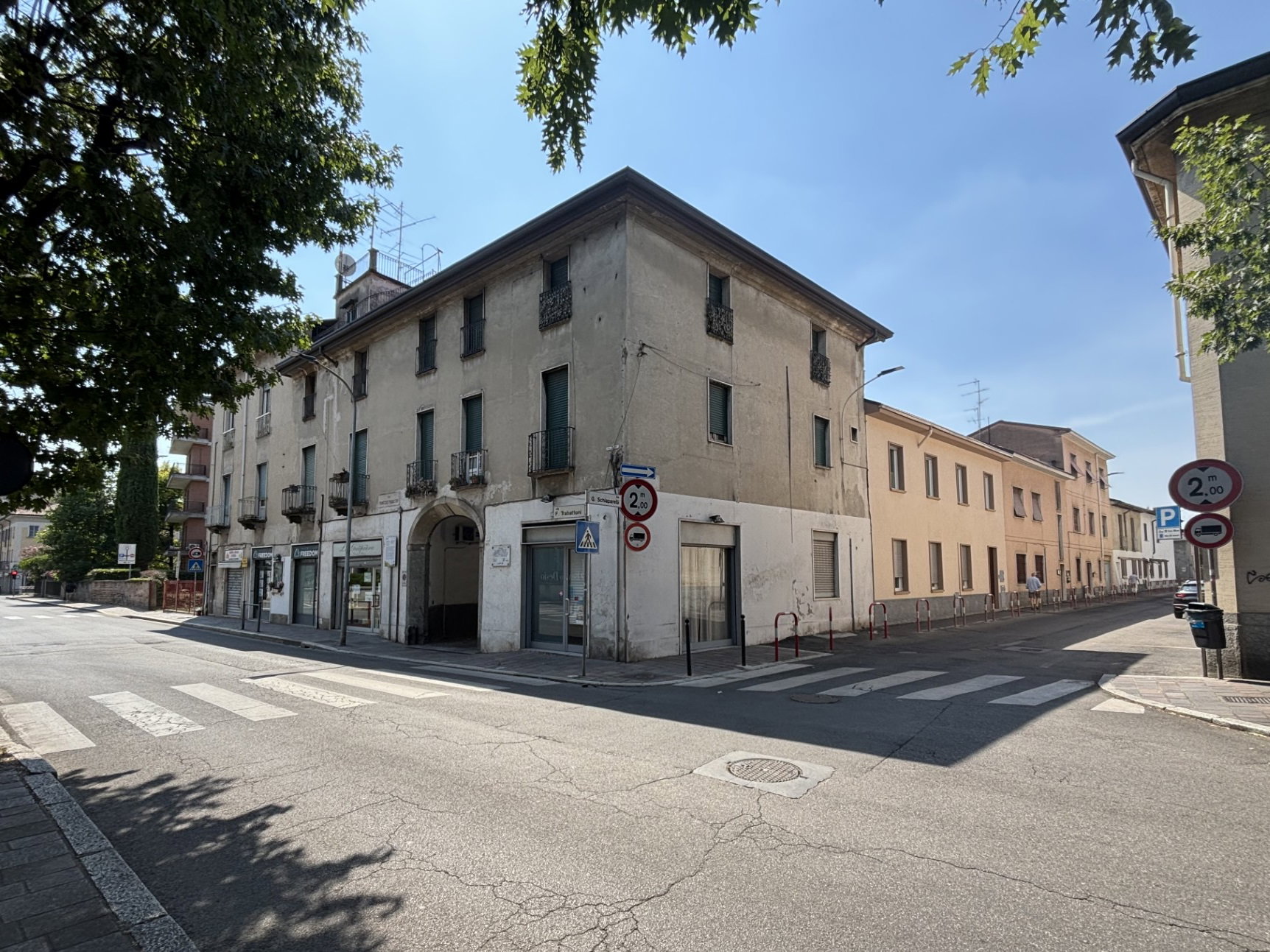
Ca Bianca- the house which provided shelter for the Gani family . Just outside the pedestrian centre of Seregno
Giuseppe Gani was born in 1895 at Ioannina in the Epirus region of Greece. Ioannina sits on western shote of Lake Pamvotis , 255 miles northwest of Athens. Although it might have been a Hellenistic settlement , it is usually said to have been founded by the Byzantine Emperor Justinian in around the 6th Century AD. After the sack of Constantinople in 1205. Many wealthy Byzantine families moved there and the city prospered, becoming particularly valued for its textiles and silverware. Ioannina fell to the Ottomans in 1430 and remained under Ottoman occupation until it was finally ceded to Greece 1913, following the first Balkan War.
There had been a Romaniote Jewish population in Ioannina for at least the preceding 1100 years., they were one of the oldest Jewish populations in Europe . It was a historic population distinctly separated from the Sephardic Jews who had settled in the Ottoman Empire after their expulsion from Spain and Portugal. It was said that there had been a synagogue in Ioannina since the 9th Century AD. At the time Giuseppe’s birth in the 1890s, the city had population of around 77258 Greek Orthodox Christians, 4759 Muslims and 3334 Jews. Although not actively persecuted the treatment of the Greek Jews was somewhat dependent on random whims if the Ottoman Empire. So it seems that on the whole the Jewish population were pretty glad to be liberated by the Greeks in 1913. The period of the First World war saw a notable diminution in Ioannina’s Jewish population, whether because of the economic downturn, political turmoil or to avoid conscription in the Greek Army many of the Jewish population left. Many went to the United States. From Ioannina it was only 50 miles to the port of Igoumenitsa on the Ionian sea and a few hours by boat from Brindisi in Italy. Twenty three year old Giuseppe Gani also decided to leave Greece , because in 1918, he was registered as a resident in Milan. In 1925, he married Speranza Zaccar, she was also of Greek Jewish origin , from Corfu. Giuseppe seems to have established a successful textile business and the family had three children Regina (1926) , Ester (1928) and Albert (1934) . They were clearly doing well, Giuseppe had his own business and the family were living in central Milan in Corso Vercelli 9. However, that would unfortunately be the high point of their fortunes.
In 1938, the Italian King signed the notorious Racial laws. Foreign born Jews who had moved to the Kingdom after 1 January 1919, were required to leave the Kingdom before 12 March 1939. This resulted in the expulsion of some 5,000 foreign Jews. Giuseppe had beaten the deadline by being resident in Italy for in 1918, presumably Speranza may have been in the same position. The Racial laws also provided for the expulsion of Jewish children from Italian Public Schools. Twelve year old Regina Gani was attending the middle school ( I ginnasio) of the prestigious Liceo Manzoni in Central Milan. Following the Racial Laws she was one of 64 Jewish pupils who were expelled from the school. Her education continued at the Jewish School in via Eupili, Milan .
Fortunately, there is testimony given by people who knew Regina at the time thus demonstrating the benefits of recording oral history, while there were still people around to give it. On 3 April 2003, Regina’s friend and classmate Edoarda Flack was interviewed regarding her friend. They had been together since Elementary School and had started the Liceo Manzoni together. Mrs Flack still remembered Regina and er family “all thee of the Gani children were beautiful. They were a very normal family, among other things they were quite laic, that is not particularly observant , like the rest of my own family. For example they did not observe the kashrut.” For Edoarda Flack, visits to the Gani house meant that she could eat bread and salami , which even though her own family were not so observant, were still forbidden in her own household. Mrs Flack recalled both her and Regina having been expelled from the Manzoni and finishing at the school in via Eupili, where rather tan normal teachers they were often taught by University Professors who had been removed from their positions for being Jewish . Notably the girls got the chance to have singing lessons with Vittorio Veneziani, former Director of the Chorus at La Scala , Milan who had been dismissed from that role in November 1938 for being Jewish. Since then he had been occupied with the choir at the synagogue and teaching music at the Jewish School. Worse was still to come. In October 1940 , the Italians invaded Greece putting Giuseppe in the unfortunate position of being not only Jewish but also a citizen of a country with which Italy was at war and which was now Allied with the British.
According to some accounts Giuseppe was interned by the Italian authorities and sent to Seregno. He was joined by his family. Despite the fall of Mussolini on 25 July 1943, the new Royal Government under Marshal Badoglio showed little inclination to rapidly release political prisoners detained by the Mussolinian regime. The Badoglio government also continued the war on the side of the Germans. It is therefore unclear as to when Giuseppe was released from internment and whether he subsequently returned from Seregno to Milan. In August 1943, in an attempt to persuade the Italians to exit the war, the British Royal Air Force had launched a series of massive bombing attacks with the intention of forcing Italy out of the war. Homing in on the Duomo as a target, these raids were directed against civilian areas of Milan and involved the use of incendiary bombs. Fortunately being solidly built of stone and with wide streets, Milan was spared the “ firestorms” which destroyed German cities, nevertheless thousands were rendered homeless and notable parts of Milan’s architectural and cultural patrimony were destroyed . Thousands of people decamped to the nearby countryside every night to avoid the bombings. On 8 September 1943, the Royal Italian Government signed an Armistice with the Allies. With substantial German forces already in Italy, reinforcements started to pour over the Brenner Pass and Milan was occupied the Germans. I effect the Italian Army garrisoning i Milan declined to arm the civilian population and allowed the city to be talked without resistance. Thereafter the whole baleful of the Nazi Regime began to arrive in Milan. Bring armed with the results of the 1939 Italian Racial; Census, which the Italians had negligently neglected to destroy, the Nazis began to hunt down the Jewish population of Milan. Against this backdrop. Giuseppe Gani arranged for his family to stay in the supposedly safer surroundings of Seregno.
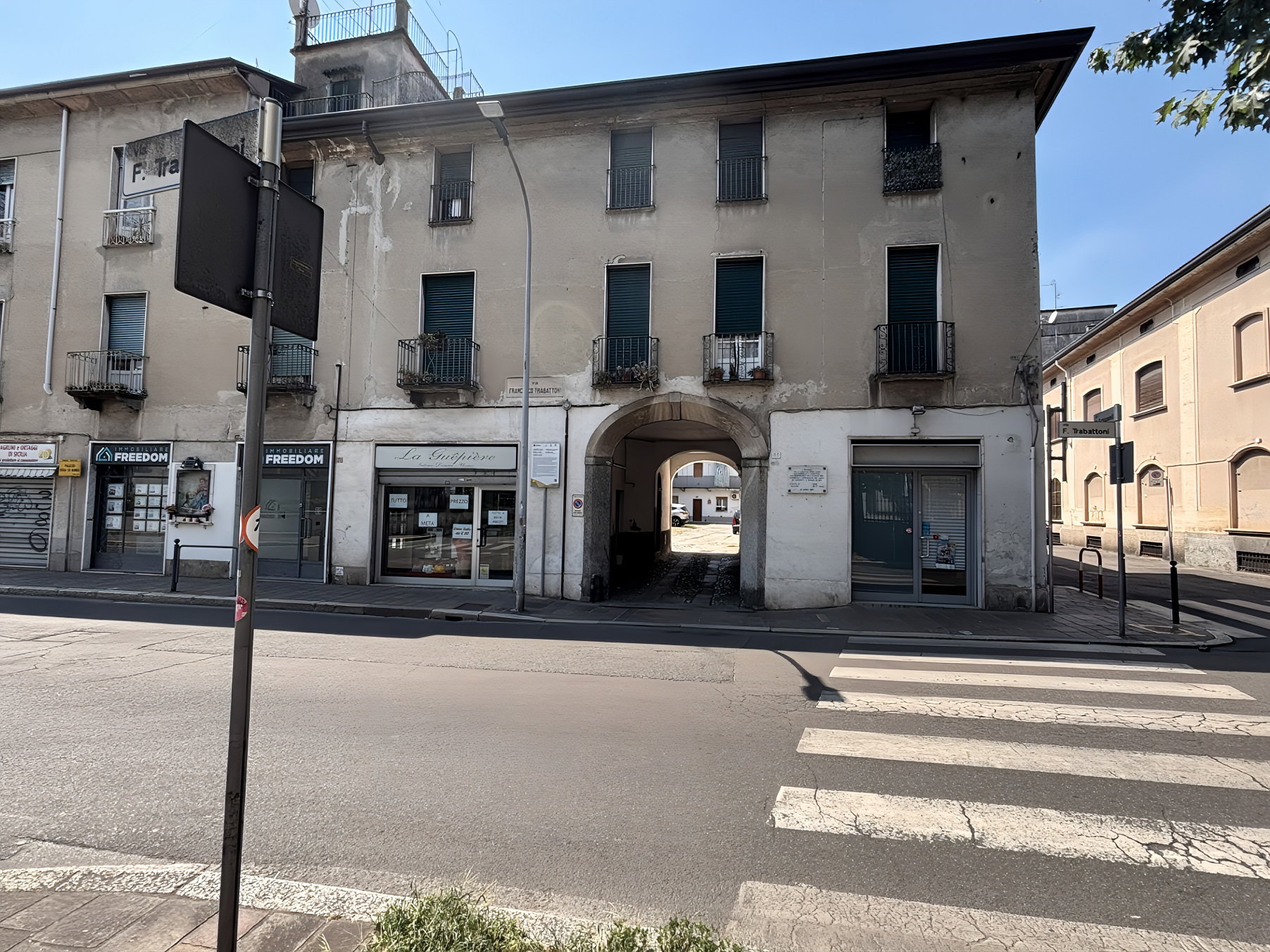
Another view of the Ca Bianca where the Gani family were sheltered by the Casati family
After moving around a bit, Speranza and the children were sheltered by an Italian family the Casati, at a house called the Ca Bianca, in Via Trabattoni, Seregno. The head of the family Luigi Casati was a labourer. Being a large family of seven children , the Casati-s apparently were not a well to do family and lived in cramped conditions they, but what little they had they were prepared to share with Speranza and her children. Motivated by basic humanity ad anti/Fascism, the Casati managed to shelter the family through the end of 1943 and up to August 1944. In February 1944,the Fascist authorities in Milan confiscated the Gani’s apartment in Corso Vercelli and around the same time their Bank Accounts were also blocked, before finally being confiscated in October of that year. Unfortunately not all Italians were as decent as the Casati family. It appears to have been an open secret that they were sheltering a Jewish family and in August 1944 they were betrayed. If anybody knows who by, they aren’t telling. Maybe somebody did it for ideological reasons, often they did for the money . The war and German occupation had destroyed the economic and social fabric of Northern Italy and some people were maybe just desperate enough or did no care enough to betray Jewish neighbours for the cash. Whoever did it must be long dead with that particular stain on their soul.
Apart from Mrs Flack, Fernanda Casati one of the youngest of the Casati children was still around to be interviewed in 2003 at the age of 79 and to give her recollections of Regina Gani
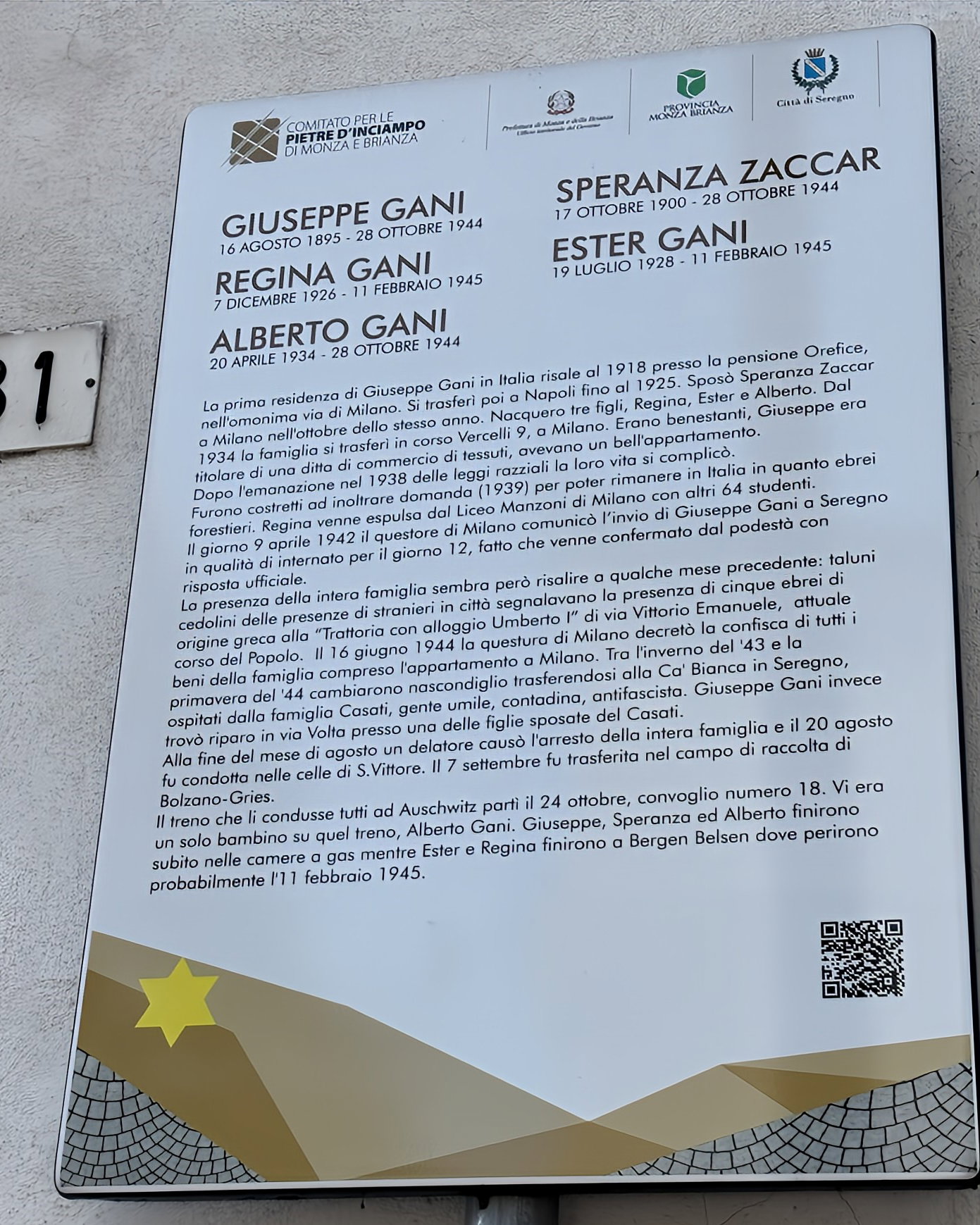
Commemorative sign outside the Ca Bianca
So the Fascist militia arrived at Ca Bianca to take Speranza and the children away. Giuseppe was living elsewhere in Dosso in a semi-rural area to the east of the city but he too was picked up in the next days. The whole family reunited were then passed through the topography of terror that the Germans established in Northern Italy. Maybe the family passed through police barracks n Seregno and Monza before sent to the notorious Wing, number 4 of the San Vittore Prison in Milan on 25 August . San Vittore never held the prisoners for long, just until enough had been assembled to be taken elsewhere . When prisoner numbers were sufficient they were taken under cover of darkness to Milano Centrale . There at Binario 21, on 7 September they were loaded into cattle trucks at the secret underground platforms which had originally been designed to load the mail. The cattle trucks were raised by elevators to the railway line and then followed a harrowing journey of many hours to reach the holding camp at Bolzano-Gries. This transit camp was used to assemble prisoners from all over Italy ready for transportation over the Brenner pass to the death camps of Eastern Europe, at Bolzano the unfortunate family had to wait for enough victims to be assembled for the final journey to Auschwitz. They were deported on convoy number 18, on 24 October 1944. After an agonising four day trip on the night of 28 October the family arrived at Auschwitz , Giuseppe, Speranza and Albert did not pass the selection test for work. They were immediately sent to the gas chambers. Regina and Ester were separated from their parents and brother, presumably regarded as fit to work by the Nazis. As the Soviet Army advanced relentlessly through Poland, the Germans abandoned Auschwitz and in attempt to cover up their tracks forced the prisoners to join death marches to the West. Regina and Ester may have survived even those , they were apparently last witnessed of at Beren Belson in Western Germany in February 1945. After that nothing is known of their fate.
The Jewish population of Ioannina from where Giuseppe had arrived fared little better. On 25 March 1994, 1870 Jews were deported from Ioannina to Nazi concentration camps . After a horrendous journey they reached Auschwitz on 11 April 1944, on which date or shortly after tey were murdered, Only 112 Ioannina Jews are known to have survived Auschwitz. Ant famed of Speranza remaining in Corfu would not have fared any better. On 9 June 1994. The Germans rounded up 1795 Jews in Corfu and deported them to Auschwitz. Only around 200 Corfiot Jews survived the holocaust. the house in via Trabattoni is still there today, there are a couple of commemorative plaques placed by the City of Seregno and the five stolpersteine placed in the pavement to remember the Gani family. The school library at the Liceo Manzoni is named in memory of Regina Gani. If one of the aims of the Nazis was to eradicate the memory of Europe-s Jewish population, they singularly failed. It seems beholden on everybody to keep alive the memory of families like the Gani family. The Nazis may have been able to kill the Gani family, but have been unable to eradicate their memory.
The story of the Gani family has appeared over the years on many Italian websites and newspaper articles. Most of the detail appears to come from an excellent local history book. Published in 2011, and expertly researched by local Seregno historian, Pietro Arienti " Dalla Brianza ai Lager del Terzo Reich", tells the story of all the deportations from Brianza after September 1943..
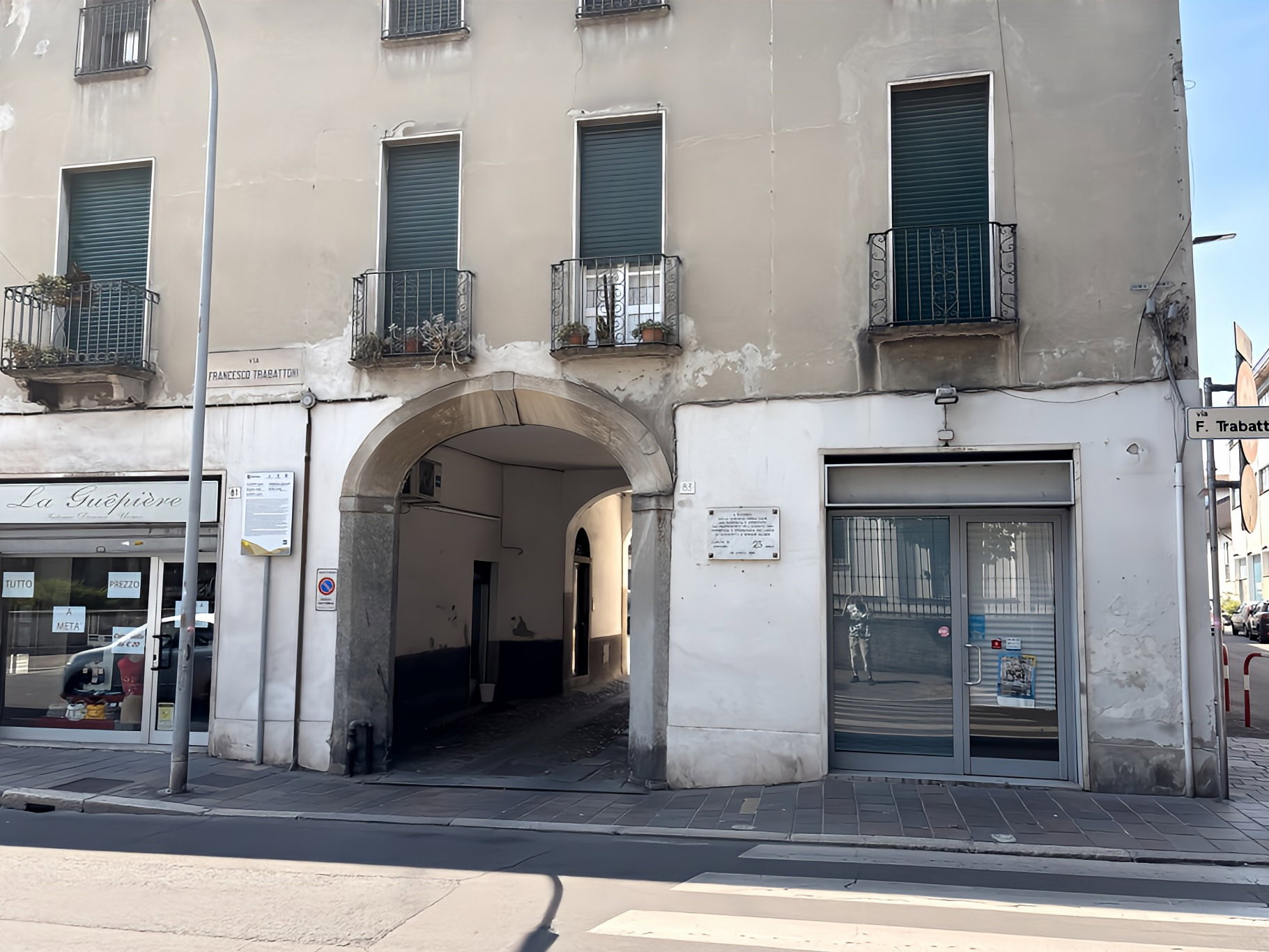
The Gani family were taken out through these gates in August 1944, destined for Auschwitz
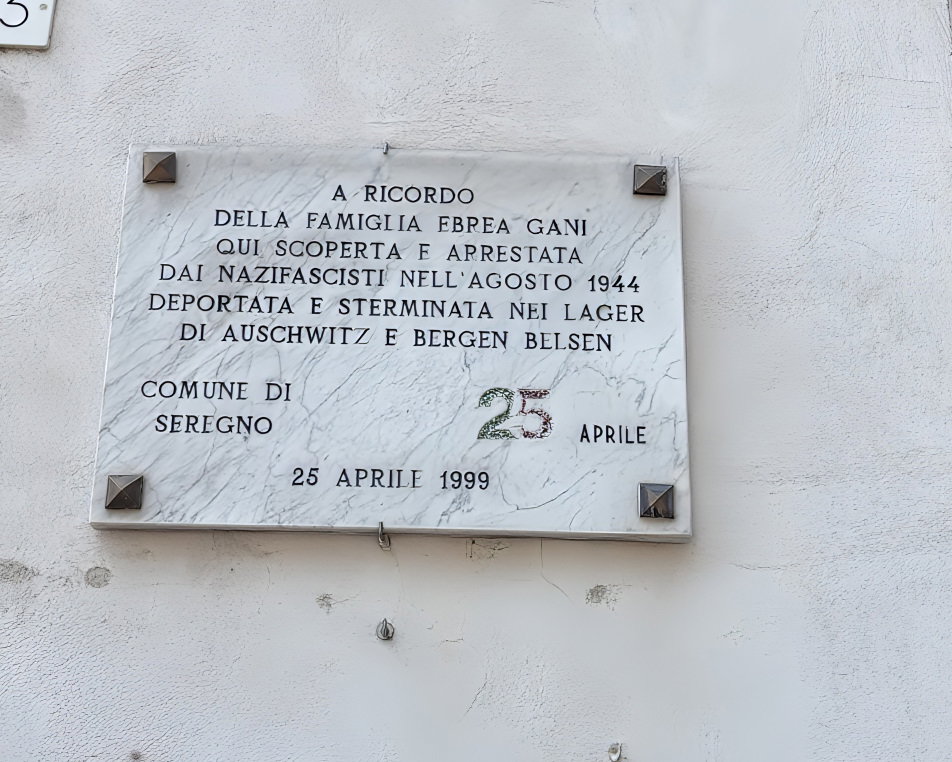
Commemorative plaque from the City of Seregno erected in 1999