On the trail of British Railways in Italy
After writing about the Fell Mountain Railway, I thought it was worth looking at some of the earlier British constructed railways in Italy. So I made a day trip along the Novara to Turin railway and its British constructed branch line from Chivasso to Ivrea. It was all done in one day., with limited time to get off and have a look around the main sites of Novara, Chivasso and Ivrea.
One of the backers of the Fell Mountain Railway, Thomas Brassey had a long history in successful railway projects in the United Kingdom and France. In the 1850s he became involved in important projects for the Kingdom of Sardinia and Piemonte. The key man in all this was Camillo Benso, conte di Cavour, president of the Consiglio (Prime Minister) of the Kingdom. Cavour needed capital for railway construction and looked to the British for help. Negotiations were accordingly commenced for the construction of a railway from Turin to Novara. Cavour negotiated with Thomas Brassey, Frank Mills, and George Giles as the contractors who, under the sole name of Mr. Brassey, arranged the conditions of a concession from the Piedmontese Government to construct the Turin to Novara line.
The Turin to Novara line was by no means the first railway in Piemonte. The 166km railway from Turin to the port of Genoa had been completed on the 18 December 1853. A separate 67km track had been built connecting Alessandria with Novara which was finished on 3 July 1854 and then a further 36km stretch between Novara and the lakeside port of Arona on Lake Maggiore was completed on 14 June 1855. The intention had been to continue that route by tunnel through the Lukmanier pass into the Canton of Ticino in Switzerland , but that plan never came to fruition. Instead ferries continued to take people from Arona towards Locarno on the Swiss end of Lake Maggiore . Thomas Brassey had already been involved in looking at that project . Novara was the second largest city in Piemonte and connecting it to Turin and on to Genoa made good sense. The new line lapsing through Chivasso, Santhia and Vercelli would open up the important rice growing areas of Piemonte to the railway. From Novara it would also be a short distance to connect with the railway system in Austrian ruled Lombardy.
British interests in Piedmont were helped immensely, by Sir James Hudson as the Minister at the British Legation at the Palazzo Cisterna in the centre of Turin who was to prove invaluable in smoothing contacts between British railway contractors and the Kingdom of Sardinia. Hudson had three years in Italy on the Grand Tour in the 1820s and then entered the service of King George III as a page working his way up in the Royal Household. After the accession of Victoria, Hudson became a diplomat and having served at the British Legations in Washington, The Hague and Rio de Janeiro, he was posted to the Grand Duchy of Tuscany, and in 1852, arrived in Turin specifically to promote representative democracy in the Kingdom of Sardinia.
After serving a military engineer Cavour had been held as a political prisoner in Fort Le Bard, on his release he had embarked on a tour of France and England. While studying English political life and institutions, Cavour took the opportunity to take a couple of train rides from Woolwich Arsenal to London and from Liverpool to Manchester. and became enthused with the railways. After his tour of England, Count Cavour had returned to Piemonte and was managing the family estates at Leri and refraining from political agitation. His trip to England had revealed to Cavour the immense changes which railways could make to all parts of modern life. He had promoted the construction of a line between Lyons and Geneva and encouraged the laying-out of a system to connect Turin with the chief Piedmontese cities with the plan of a tunnel through the Alps. Cavour had a vision of how things would change:
“In a few years, the basin of the Po will be crossed in all directions by a vast system of iron roads, which will connect all the principal points of the country, and which, extending towards France by Savoy and towards Germany by way of Trieste, will put Italy in constant communication with the continent of Europe”
A preliminary agreement was reached between Thomas Brassey and Pietro Paleocapa, the Minister of Public Works for the Kingdom of Sardinia. Paleocapa, whose family was of Greek origin was a trained engineer, who had served with the Genio ( the Army Engineers ) . He had later joined the “Corpo degli Ingegneri di Acqua e Strade” of Venice, where he studied canals and railways. When the Austrians resumed control of Lombardy and Veneto, he stayed in the Kingdom of Sardinia , becoming Minister of Public works in Turin and. With his background he would have been able to talk to Brassey on the same level.
The Piedmontese Government was to subscribe 25% of the capital for the Turin to Novara line , Thomas. Brassey 25%, the Provinces a 25%, and the public 25%, no interest being guaranteed. The Piedmontese public, not understanding railway matters remained indifferent in their enthusiasm for subscribing for their allocation, so Cavour requested Brassey to take up half of the deficiency, if the Government took the other half. Brassey agreed. The Piedmontese then decided they liked railway investing and applied for a very much larger amount of shares than that which had been originally offered to them. Cavour was then forced to ask if Brassey would give up some of the shares Cavour was anxious to whet their appetite for other enterprises by letting them taste a profit on their first speculation . Brassey willingly gave up 2,000 shares, even though they were at a premium.
The Turin to Novara railway opened on 20 October 1856 and traffic proved far more remunerative than originally estimated, and the line was completed at a lower cost than had been expected. Brassey, remarked, ' That railway has been completed for about the same money as was spent in obtaining the Bill for the railway from London to York! The length of the Turin and Novara Railway was 60 miles.
Cavour remained grateful to Brassey, and repeatedly thanked him for the liberal and spirited way in which he had responded to the wishes of the Piedmontese Government. He reportedly said of Brassey
” (he) is one of the most remarkable men I know ; clear-headed — cautious, yet very enterprising — and fulfilling his engagements faithfully. We never had a difficulty with him. He would make a splendid Minister of Public Works “.
I arrive at Novara from Milan. Up until 1860, the frontier between the Kingdom of Sardinia and Austrian occupied Lombardy was the Ticino river. The train from Milan passes through Magenta, the site of the famous battle between the Italians and French against the Austrians in 1859 and crosses the Ticino near Buffalora,. The Austrian built the railway as far as their side of the river. The stretch on the Piemonte side, between Buffalora and Novara was bult by another British railway contractor Charles Henfrey.
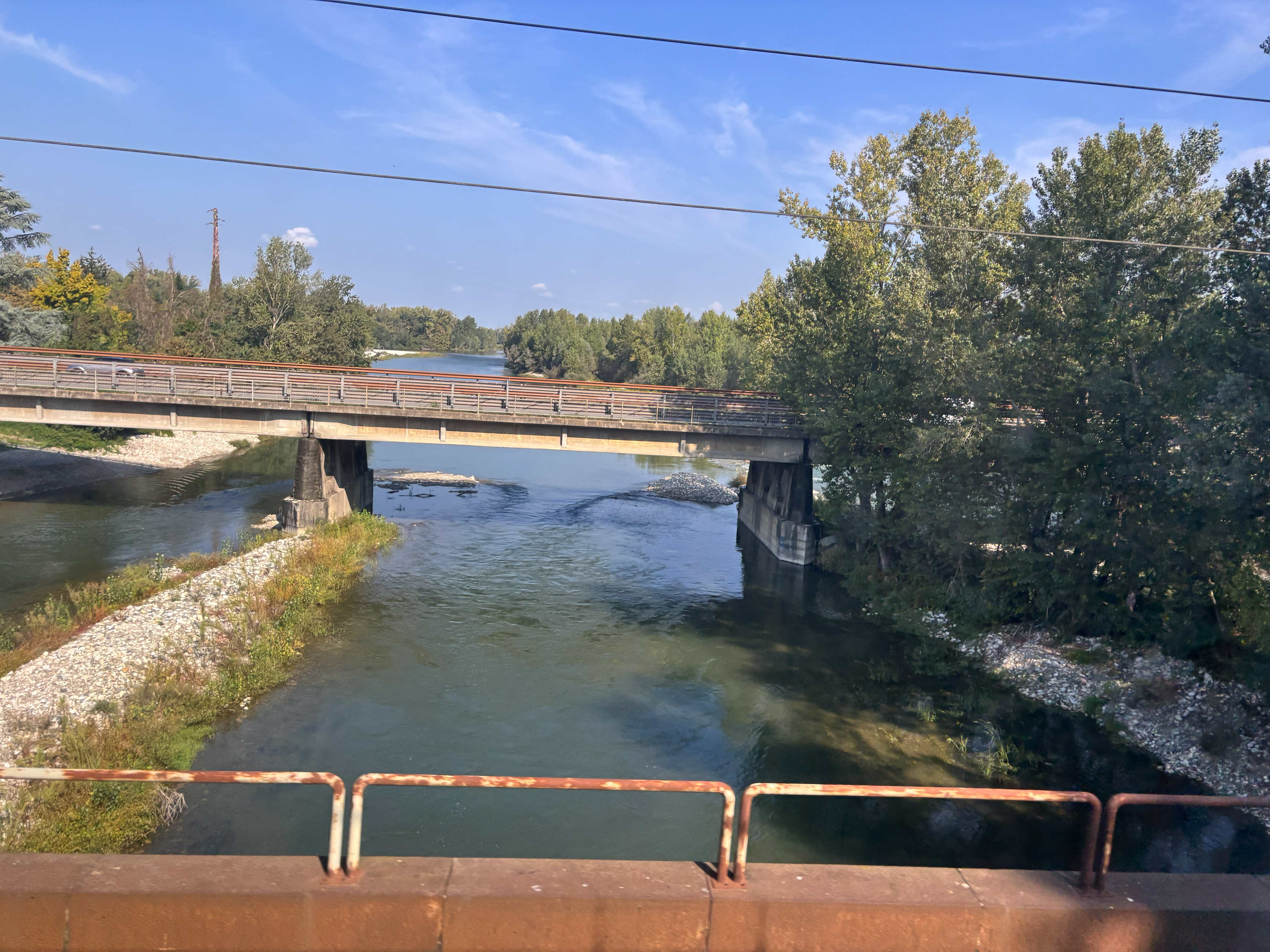
Crossing the Ticino- the former border between the Kingdom of Sardinia and Austrian occupied Lombardy
Novara was and is still after Turin, the second largest city in Piemonte with just over 100,000 inhabitants, at the 1861 census its population was 25,144. Novara station is a rather fine looking building originally constructed in 1854 for a line from Alessandria to Novara. It has obviously been constantly expanded and modernised with 12 platforms and al the usual infrastructure of modern railway stations, but the old core of the station is still there. From the station it is a short walk to the centre to have a quick explore of the city.The arrival of the railway and the construction of the station seems to have opened up new possibilities and development for Novara, In 1857, a British correspondent wrote to the Times:
“The prosperity of Novara shows itself the moment you approach the railway station. New houses and manufactories are springing up on all sides, and the municipality has just now begun enlarging the street from the railway station to the centre of the town at an expense of 350,000f. in indemnity to householders, besides 100,000f. to be spent in public embellishments of it, and has determined to build warehouses at the station, which will cost over 600,000f. An entire new quarter is being constructed near the railway station, and, as all building is more or less under the surveillance of municipalities in the town and country, that of Novara appears to be acting with much good taste and discretion, and has an income of 500,000f., which it employs in improving its city, a stranger arriving at Novara cannot help being struck by the evidences of progress that offer themselves on all sides. There are a great many charitable institutions in Novara that are well worth being visited, and their management inquired into. Silk manufacture is progressing fast, and recently a company has been formed under the presidency of Cavaliere Rossi; the Syndic has cast aside the old system of spinning, and has given a remarkable example of progress by erecting machinery and a steam engine, the former invented by Mr. Dickens, of Middleton, near Manchester, and both made by Messrs. Gordon and Co. of Stockport, and which have just been proved most successful and given intense satisfaction to the shareholders. The advantages of this new system are that greater evenness of thread and elasticity is obtained at a less expense than by any other means yet tried. In cotton there is also an extensive establishment belonging to Messrs. Crevelli, Arioldo, and Co. worked by turbine, where there are at present works for cleaning, spinning, and dyeing cotton, but where the proprietors are now adding steam to water power, and are about to set up 100 power looms.”
It is interesting to note that other British businesses were obtaining the benefits of the British built railway, with the expertise and machinery on offer from the British Silk industry, which at the time was mainly centred on the North West of England around Macclesfield and Stockport. Where British railway engineers had led, other British industries were able to follow.
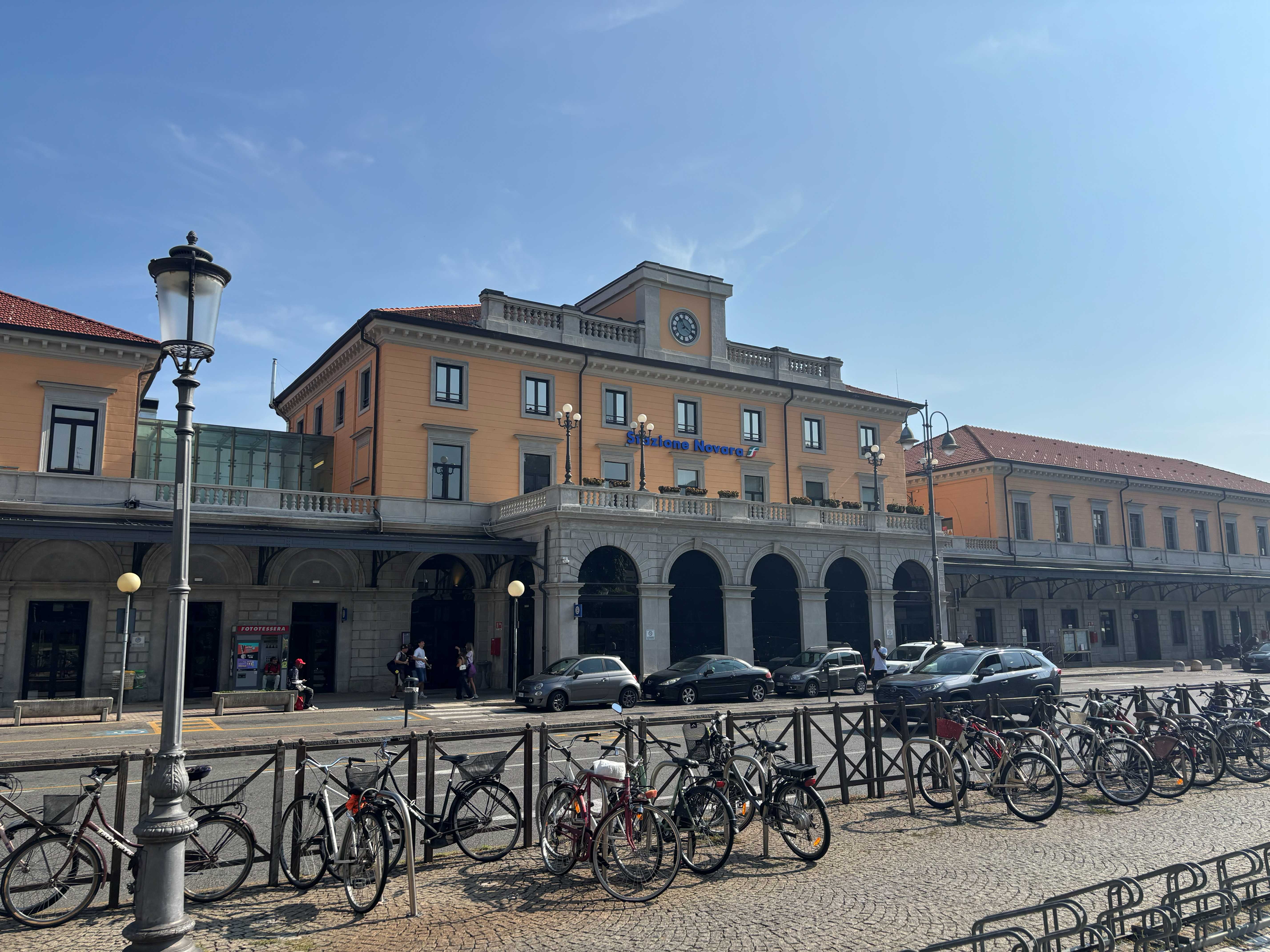
Novara railway station, the original parts date back to the 1850s- obviously much expanded and modernised since then
It is an interesting and pleasant city to leave the train and have a quick walk around. The centre is eminently walkable with the main area pedestrianised. I was surprised to find that Novara is the original place of origin of Campari, which I always thought was Milan. But no , in the centre of town you can find a small plaque commemorating that yes , this is where Gaspare Campari originally invented his eponymous beverage .
In 1842 Campari moved to Turin, to study liqueurs and deepen his knowledge of spirits; here he fortunately met Teofilo Barla, master pastry chef of the House of Savoy, who recommended him to Giacomo Bass as an apprentice in his famous liqueur and confectionery in Piazza Castello in Turin. In 1850 he returned to Novara where he rented the Caffè dell'Amicizia, which was located between Corso Cavour and Corso Italia, at the time called Angolo delle Ore. Campari experimented with innovative liqueurs the most successful of which was the Bitter all'uso d'Hollanda which became so popular that it earned the nickname of "Bitter del Signor Campari" from there to the definitive name.
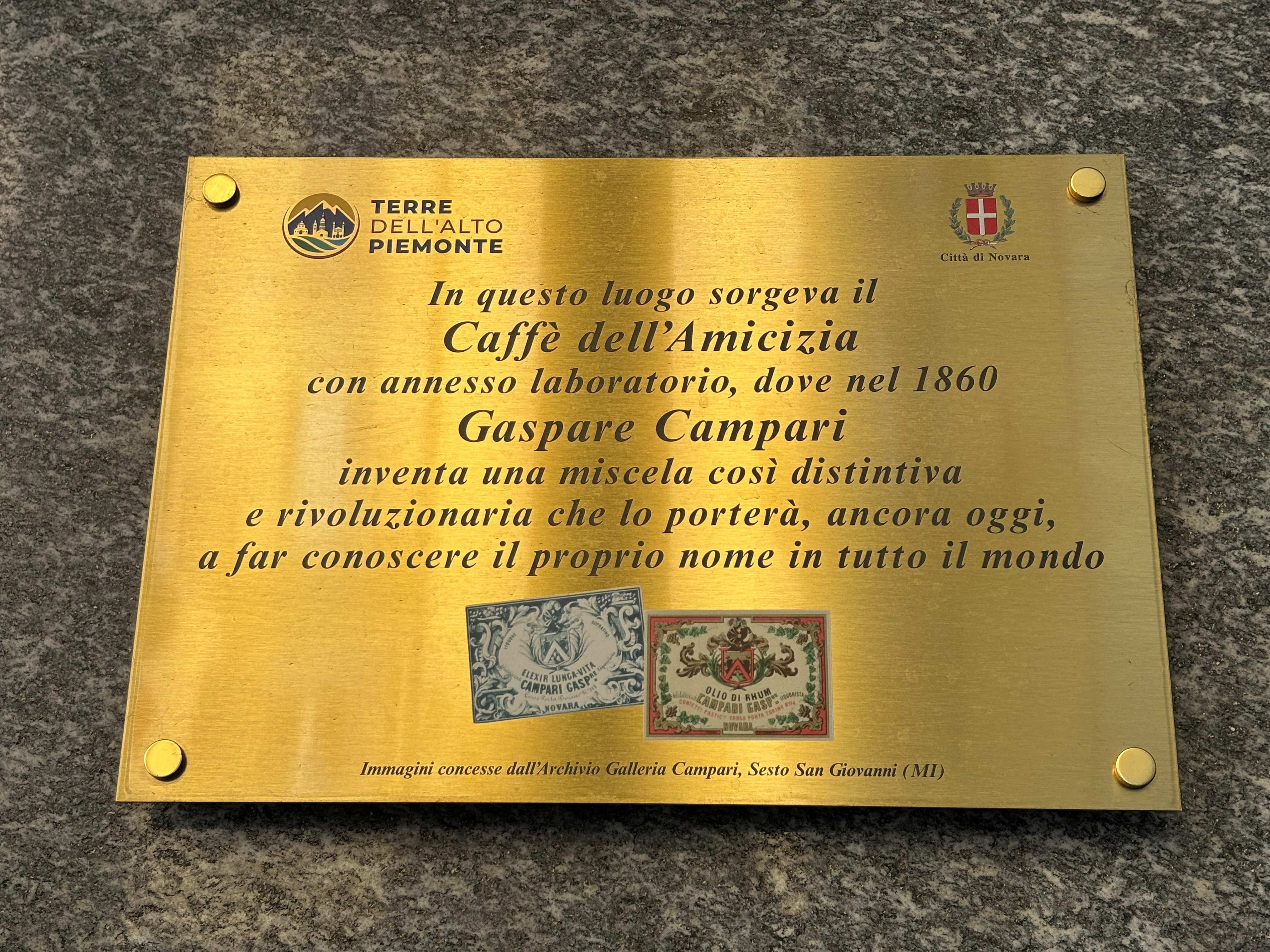
Novara was the original birthplace of Campari
Since there is limited time in each stop , I head for what must be Novara- must see attractions Basilica di San Gaudenzio. The cupola of which can be seen from miles around. Actually , the cupola a later addition which was not finished until 1876, so would not have been visible when the railway was being built.
Gaudenzio di Novara was the first Bishop of Novara . Legend has it that he was converted to Christianity in by Eusebio the Biship of Vercelli. He is supposed to have be born in Ivrea and a friendly with St Ambrose of Milan . So when in 1576, the Spanish rulers of Novaa decided to build a new basilica on a commanding height within the city, it seemed appropriate to name it for Saint Gaudenzio. The basilica is in thee parts . The original part was designed by the noted architect Pellegrino Tibaldi whose works can be found in Pavia, Milan , Ancoma and as far away as the Escorial Palce in Spain.
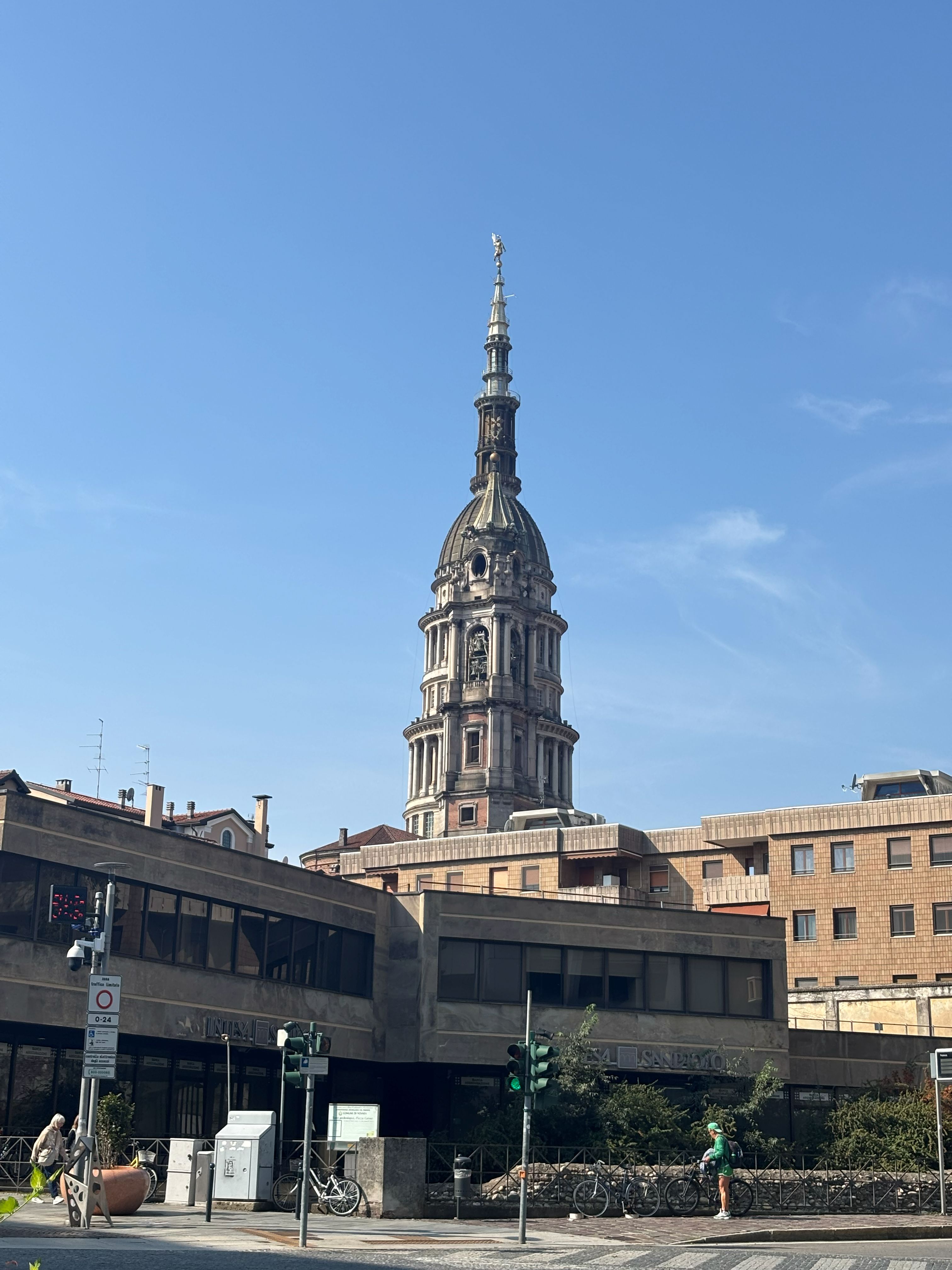
Antonelli's Cupola visible from all over Novara
The second chapel on the left side houses the large two-storey polyptych painted by Gaudenzio Ferrari in 1516.. The work was previously preserved in the old basilica of Novara and brought to the new basilica on its construction . The work is divided into three parts:
- in the upper panel are depicted, from left to right: the archangel Gabriel, the Nativity, the Virgin Annunciation
- in the lower panel are St. Peter and St. John the Baptist, the Madonna and Child between Saints Ambrose and Gaudentius, St. Paul and St. Eusebius or St. Agabio.
- in the predella 10 small panels in brown and white lead depict St. Ambrose, St. Gregory the Great, St. Jerome, St. Augustine, alternating with episodes from the life of Gaudentius.
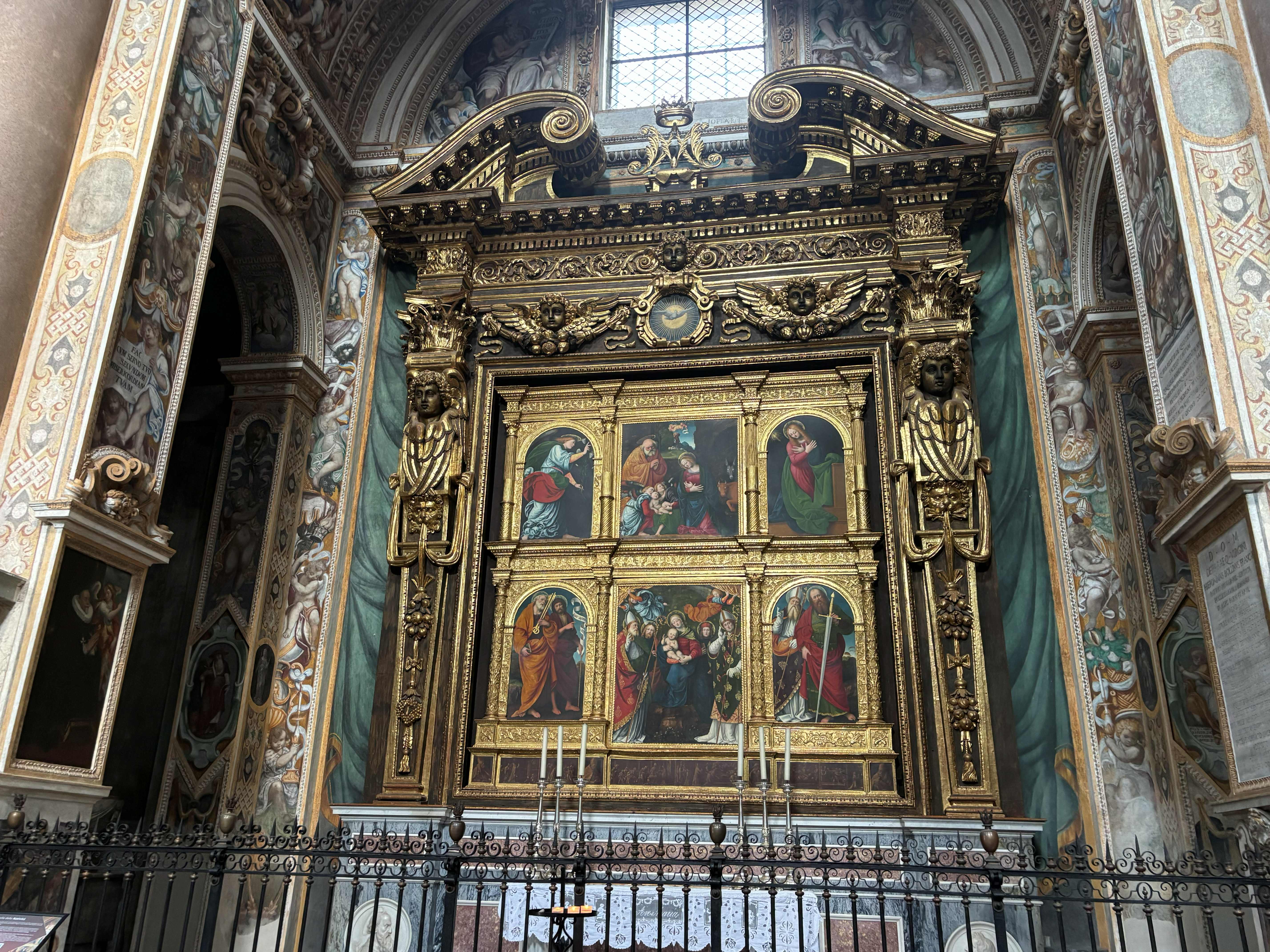
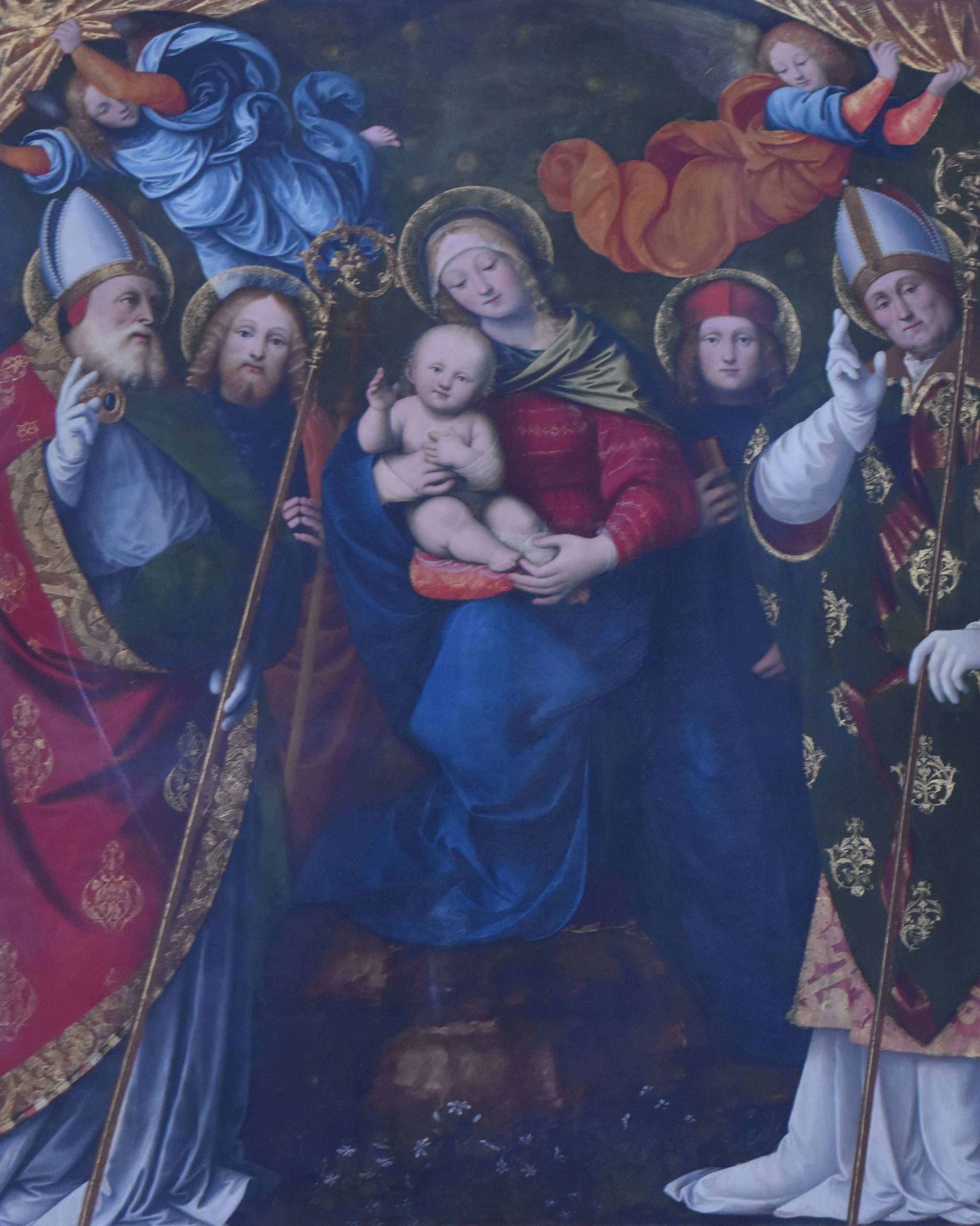
The frescoes decorating the chapel are by Paolo Camillo Landriani while on the left there is a portrait of the Jerusalem knight Gerolamo Bollini.
The bell tower is a later addition to the complex , it was the work of Benedetto Alfieri an architect who worked for the Houe of Savoy , and built between 1753 and 1786. It is located isolated from the church, to the left of the apse, and is made of bricks and granite from Baveno. It reaches a height of about 92 meters[ and is the tenth tallest in Italy. In 1773, when only the belfry was missing, the work was suspended due to lack of funds. The work was then completed only in 1786, 33 years after the opening of the construction site and 19 years after the death of its designer. The bronze angels placed on the top are the work of Giovan Battista Agazzini from Novara.
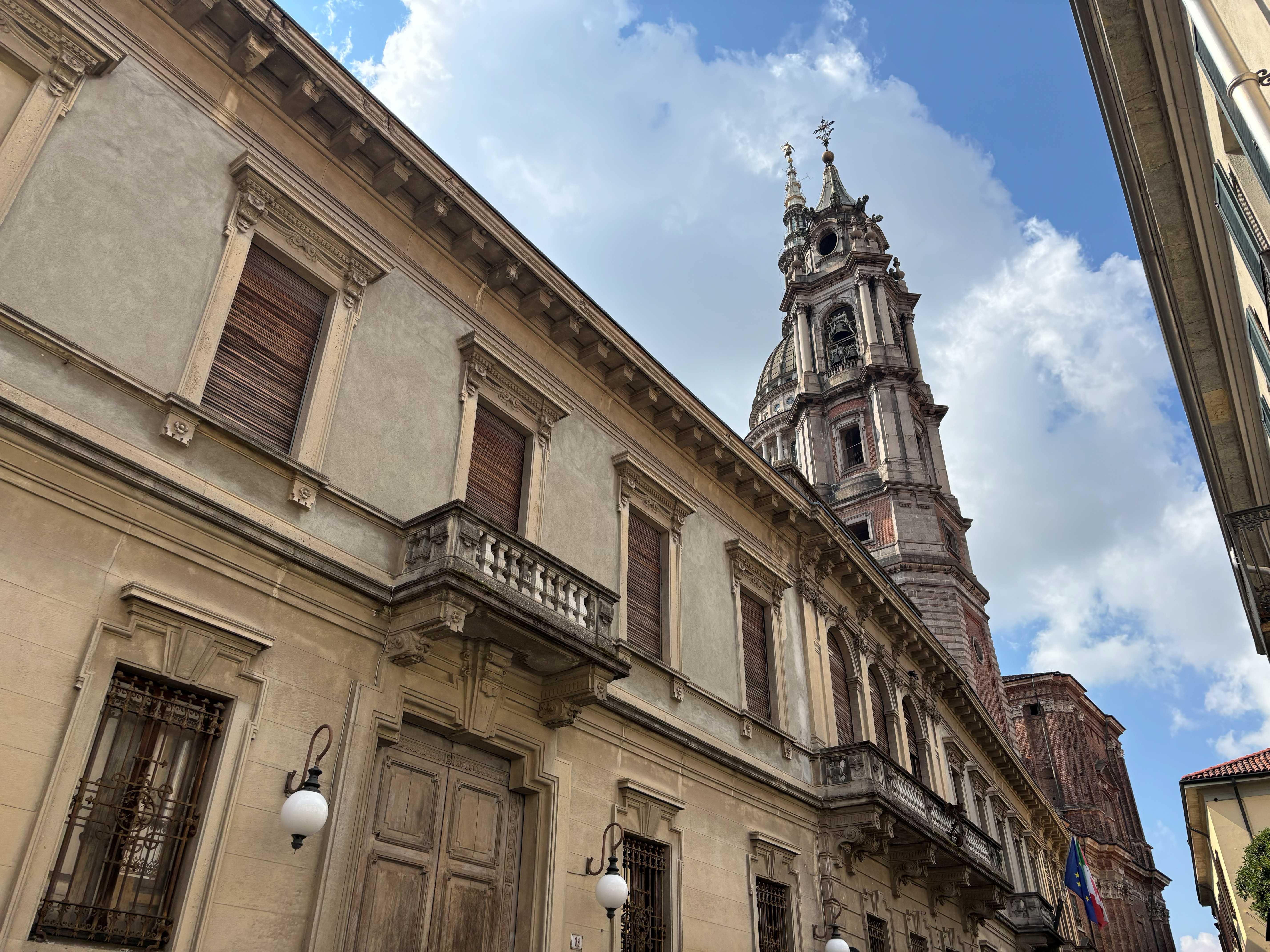
The original bell tower of the Basilica di San Gaudenzio
Unfortunately time to stay in Novara is short and I head back to the station for the next leg of the journey on this British built railway towards Chivasso. Novara surrounded by plains where the main agriculture is rice growing. Travelling through here in September the rice has mainly been harvested and the bare fields of rice stubble do not make for a particularly interesting view. It is flat and fairly monotonous and presumably did not prevent much of an engineering challenge to its British constructors. The origin of rice dates back to about 10,000 to the slopes of the Himalayas: from there the plants moved north and south with the migrations of man. It was possibly bought to the west by the expeditions of Alexander the Great. From the writings of Greek historiographers, disciples of Aristotle, it is clear that rice was already cultivated in some areas of the Middle East, but there are no traces in Greece and the rest of the Mediterranean. The Romans did not introduce its cultivation, but they knew its medical uses, in particular to treat intestinal and digestive problems and for general infections. It was after the invasion of Spain by the Arabs that rice was known and cultivated in Europe. It landed in Italy through Sicily and continued its journey in the following centuries towards Northern Italy.
The beginning of rice cultivation in Piemonte took place by the Cistercian monks from Burgundy. In 1123 they founded the Abbey of Santa Maria di Lucedio near Vercelli, reclaiming the surrounding area north of Monferrato. The name "Grange" (from the Latin granicum, deposit) derives from the farms that revolved around the abbey. Around 1400 the monks introduced rice cultivation to Italy, exclusively for medical purposes. The real turning point in rice cultivation took place in the fifteenth century, thanks to Leonardo Da Vinci's studies in agricultural hydraulic engineering, at the court of Ludovico il Moro, which allowed the management of irrigation. From the late fifteenth century there are some documents that attest to the spread of rice cultivation also in the Vercelli area. In Larizzate, on the outskirts of Vercelli, with land owned by the Ospedale Maggiore, there was a controversy in 1493 for the lack of recognition of the improvement works carried out by the tenants, including a "rice track", or rice mill. Slowly, even the areas around Cigliano, Tronzano and Santhià began to be mentioned among those most suitable for cultivation and even "very fertile" began to be defined (thanks to rice) as "the fields around the Po and from San Germano to the Sesia".
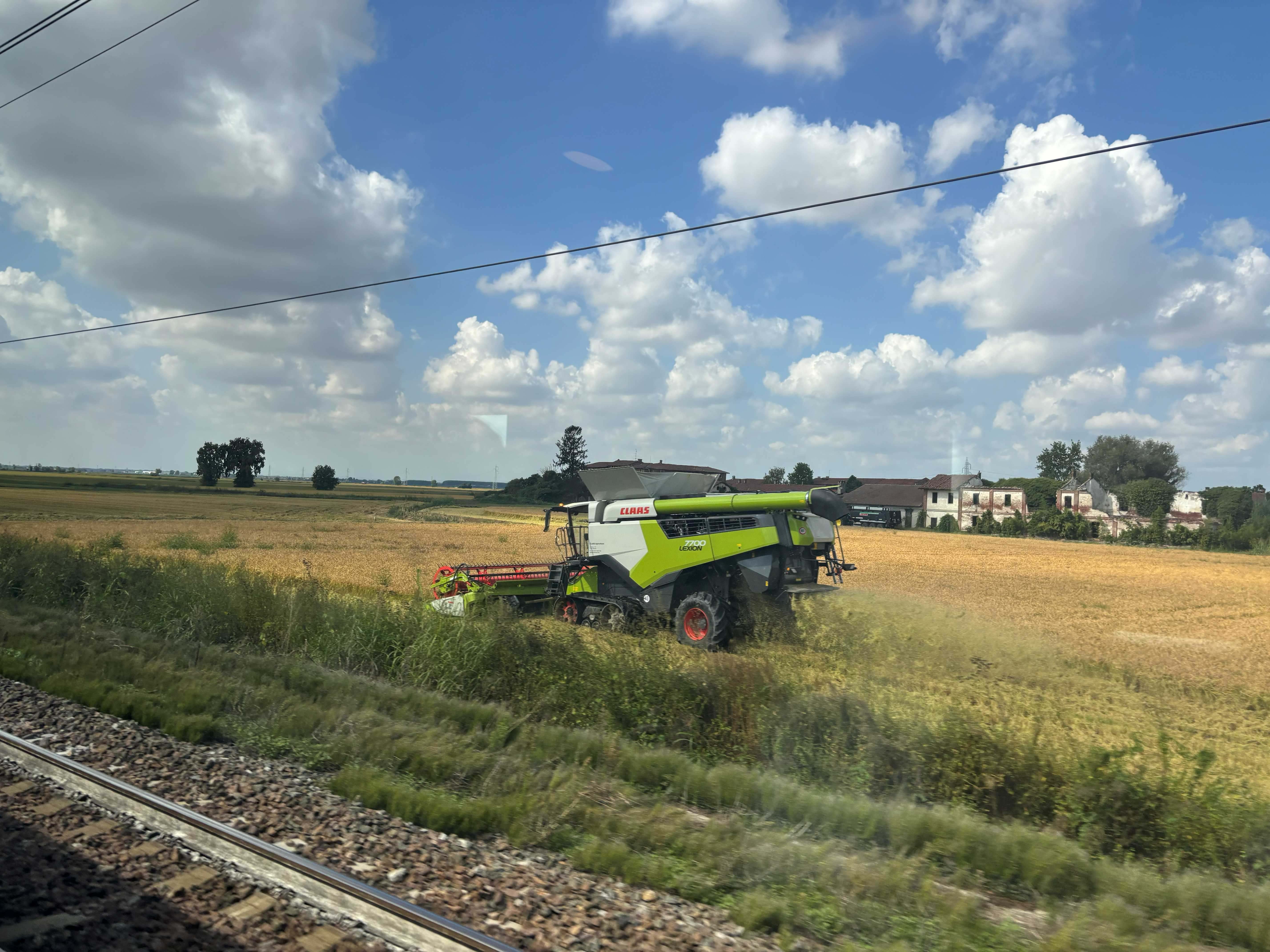
Rice harvesting in Piemonte
Rice cultivation offered new job opportunities, bringing in increasing numbers of workers, originally from the mountains or the poorest lands, who came to the plains in search of employment in the rice fields. In the eighteenth century, the Savoy sovereigns promoted the crop which, however, was also opposed due to the reputation of unhealthiness attributed to the rice field. The historical archives are full of laws promulgated to prohibit the cultivation of rice, as attested by the document signed in Vercelli, in 1571, by Duke Carlo Emanuele of Savoy. The problem was to make an increasingly profitable product coexist with the need to grow it in the middle of still water, which favoured mosquitoes as a vector for Malaria.
Rice cultivation offered new job opportunities, bringing in increasing numbers of workers, originally from the mountains or the poorest lands, who came to the plains in search of employment in the rice fields. In the eighteenth century, the Savoy sovereigns promoted the crop which, however, was also opposed due to the reputation of unhealthiness attributed to the rice field. The historical archives are full of laws promulgated to prohibit the cultivation of rice, as attested by the document signed in Vercelli, in 1571, by Duke Carlo Emanuele of Savoy. The problem was to make an increasingly profitable product coexist with the need to grow it in the middle of still water, which favoured mosquitoes as a vector for Malaria.
At the beginning of the twentieth century, rice cultivation was the clearly majority agricultural activity in the Vercelli area, where 44 of the 55 towns that are part of it grow almost exclusively rice. The rice fields are still cultivated "mutually", i.e. in rotation; only a small part of the rice grows in a "stable" way, i.e. without rotation; this second form of cultivation is widespread above all in centres such as Costanzana, Rovasenda and Palazzolo, but even more so in Desana, Asigliano, Rive, Stroppiana, where it is the prevailing method. And from here it gradually became the most widespread technique. In this way, during the twentieth century Vercelli became the Italian capital of rice, where almost everything revolves around the economy of this cereal.
Based on claims submitted by rice growers this summer, in 2025 the total area under rice in Italy is estimated at 235,450 hectares, an increase of 9,300 hectares compared to 2024. The overall figure confirms Italy as the leading rice producing country in Europe, and first in terms of extension. The national leader is Piedmont, with around 117,000 hectares cultivated this year, mainly concentrated in the two main rice-growing provinces of Vercelli and Novara. This is followed by the province of Novara and smaller plots between Alessandria, Biella and Turin. Rice cultivation in Lombardy, on the other hand, involved more than 95 thousand hectares, concentrated mainly in the province of Pavia with about 80 thousand hectares. Vercelli, Novara and Pavia alone cover 90 per cent of national rice cultivation, with an estimated production of around 1.4 billion kilos of paddy rice per year.
The train makes numerous halts at small settlements en route. They are fairly similar. Set back rom the railway each with a church tower rising above the plain. Some of the stations are surrounded by derelict warehouses formerly used for rice storage. It is an interesting if not particularly attractive route. The slow trains stop at every station on the way Ponzana, Borgo Vercelli, Vercelli, San Germano Vercellese, Santhià, Tronzano, Bianzè, Livorno Ferraris, Sant'Antonino di Saluggia, Torrazza Piemonte. During World War Two the area housed a series of work camps for British, Australian and New Zealand Prisoners of War, who were put to work in the rice fields.
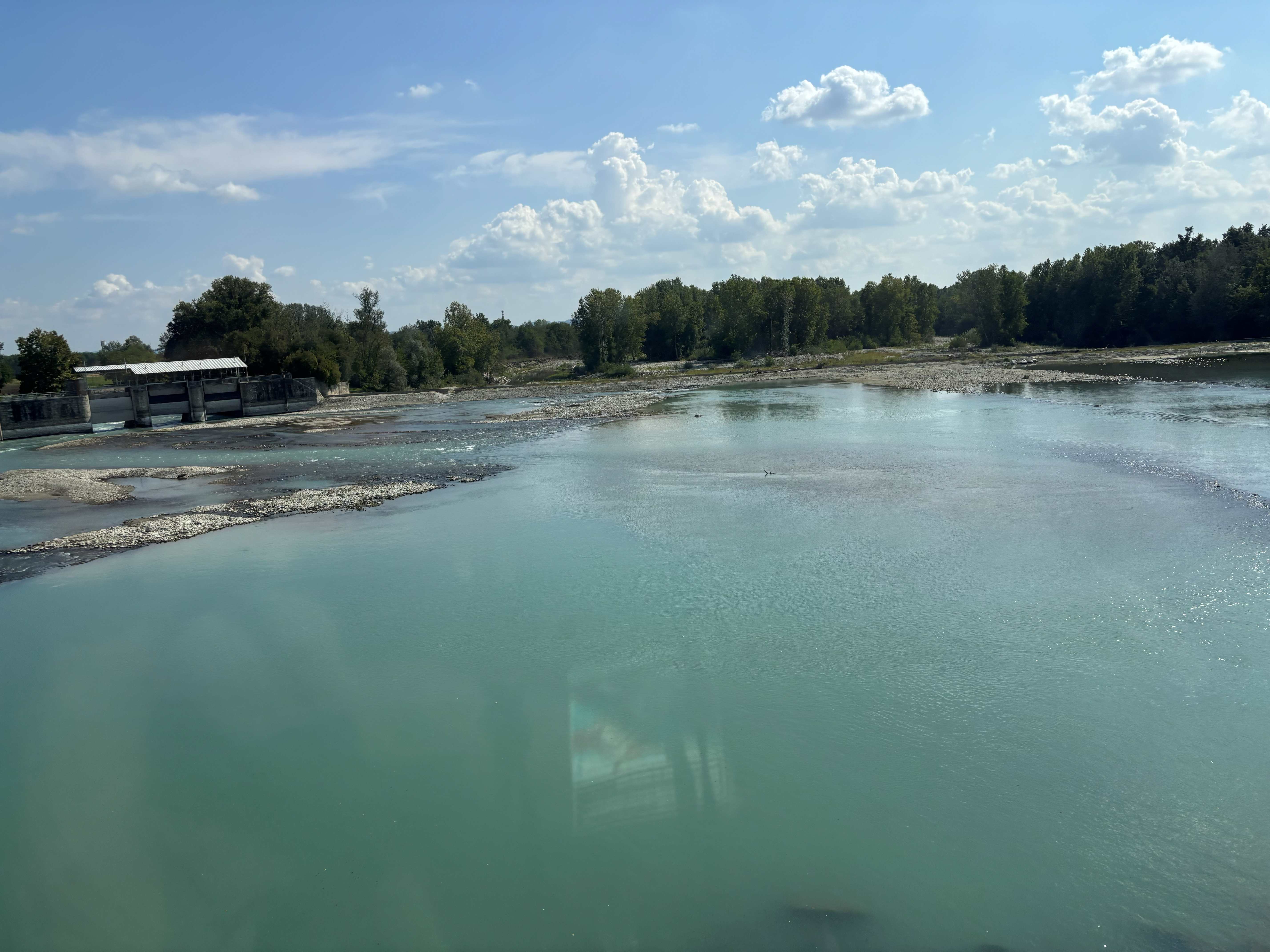
The only challenging part of the route was crossing the river Dora Baltea
Next stop is Chivasso, in 1852 the Morning Chronicle was running a series of articles on Piemonte and described the town as follows:
“The town of Chivasso is on the royal road to Vercelli, Novara, and Milan, at about nine Piedmontese miles from Turin. It was formerly a fortified place of great military importance, commanding the passage of the Po, and was considered one of the keys to Piedmont; but the fortifications were destroyed by the French in 1804. The importance, however, of this place, as a military position, is such, that the Government has determined on their restoration, which is now being effected; the Parliament having granted a large sum for that purpose. It has four parish churches, one of which, that of San Pietro, is of very elegant construction. Its date is 1425, and its front, of terra cotta, is richly ornamented with statues, &c. Chivasso, which contains 1,005 houses, 1,493 families, and 7,841 inhabitants, has three important fairs annually for cattle and all kinds of merchandise, and three weekly markets, attended by a great concourse of people from all the neighbouring districts. The town is well supplied with fish from the Po and other rivers, and a large portion of the lands in its territory is the property of the commonalty.”
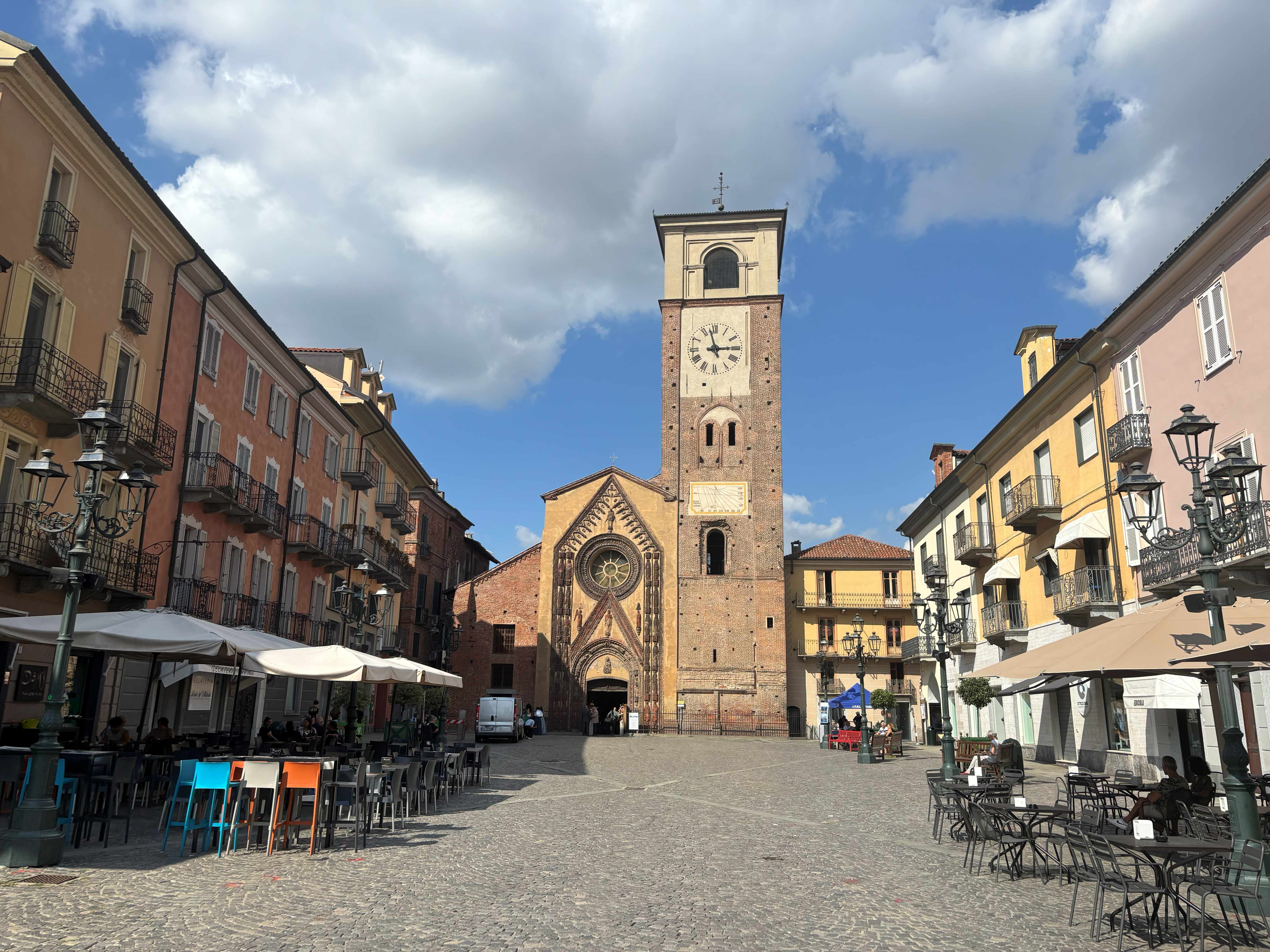
The Chiesa Collegiata di Santa Maria Assunta in Chiavasso
These days Chivasso is a compact prosperous looking town of around 24,000 people . From the station it is a short walk into the centre of town. I have around two hours to explore before the train to Ivrea is due. One of the main sights is the Chiesa Collegiata di Santa Maria Assunta. The decision to build the church – destined to become the new seat of the chapter of canons already present in Chivasso in the old western village of San Pietro – was taken by the Marquis of Monferrato Teodoro II of the Paleologi dynasty in 1415. The decision to finance the construction of the church on the then market square, near the marquis palace (of which only the mighty octagonal stone tower remains today) was part of the urban project for the embellishment of the city centre.
The construction of the church continued under Giovanni Giacomo,, burdened by military expenses he found himself unable to continue to finance the work of the church, therefore the city "Credenza" took on the burden of completing the construction. Still unfinished, the church was consecrated in 1429 by the bishop of Ivrea. In 1475 the vault of the main nave and the presbytery was raised, while the bell tower was finished in 1487. There was a wedding in progress, so I could not enter to look at the interior of the church . However, the façade of the church, with its friezes and terracotta figures, is of considerable artistic interest. These are clay works made around 1450-1460 by Piedmontese craftsmen influenced by the late Gothic style beyond the Alps. In addition to reliefs of characters modelled in terracotta, figurines of angels and putti and other ornamental motifs obtained by mould were used in the decoration of the façade. The clay decorations emphasize on a symbolic level, the entrance to the church as the gate to heaven. The cusp of the great Ghimberga is symbolically supported by twelve pairs of human figures, six to the right and six to the left of the portal; in each copy we recognize a prophet (with a heavy cap or a royal crown on his head) and an apostle (with his head surrounded by a halo), placed side by side to emphasize the continuity between the Old and New Testaments. Each figure is surmounted by a canopy, on which the figure above rests.
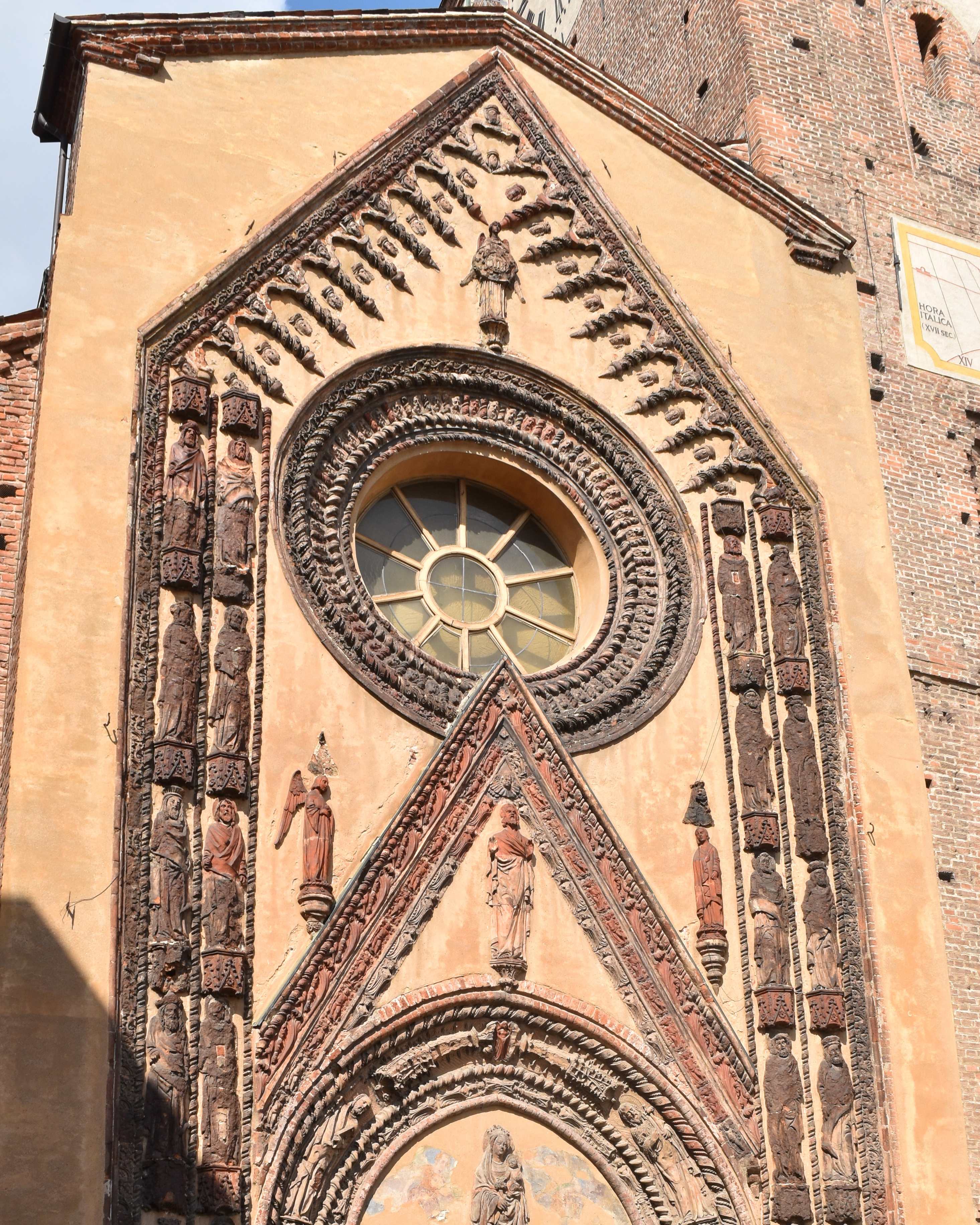
The Chiesa Collegiata di Santa Maria Assunta details of the Terracotta freizes
The portal is embellished with six other figures of saints among which James the Greater, John the Baptist, St. Peter and St. Paul can be recognized. In the centre of the lunette, among traces of frescoes now illegible, is the beautiful terracotta relief with the bust of the Madonna and Child. Immediately above the lunette, there is a second and smaller ghimberga, in the centre of which is placed the figure of the Redeemer, while on the sides we find the images of the Announcing Angel and the Virgin Annunciation. The top of the small ghimberga intersects with the rose window, in which bearded heads and other ornamental motifs are repeated in a circle.
At the top, in the large cusp appears an angel carrying in his arms a rayed tondo with the monogram of the name of Jesus in the centre made famous by the preaching of St. Bernardine of Siena. On the right of the façade is a brick construction began in 1457 by sacrificing the first of the side chapels. Originally it culminated with a high octagonal spire which was destroyed by French cannonade in the siege of 1705.
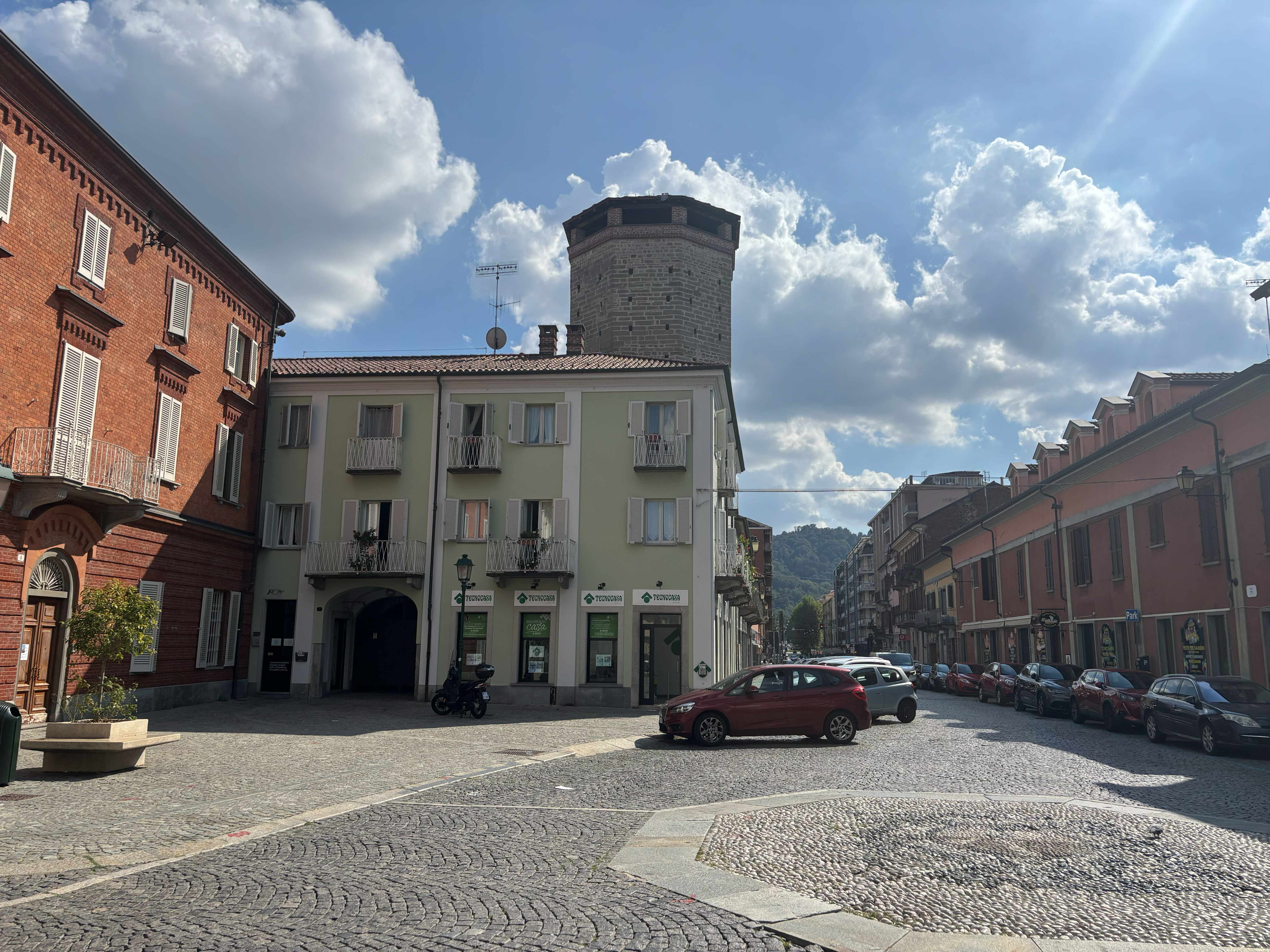
The Octagonal Tower in Chivasso-all that remains of the castle
Walking across the piazza towards the river, the Octagonal Tower is the only surviving part of a castle erected in 1178 by Guglielmo IV degli Aleramici, Marquis of Monferrato. Starting from the fifteenth century the tower was further raised by several meters with an addition in bricks.. The tower, located in the city centre, is now about 20 meters high. The roof is the result of a recent restoration work. The structure has a limestone block cladding on the outside and a brick wall facing internally culminating in an eight-segment pavilion vault.
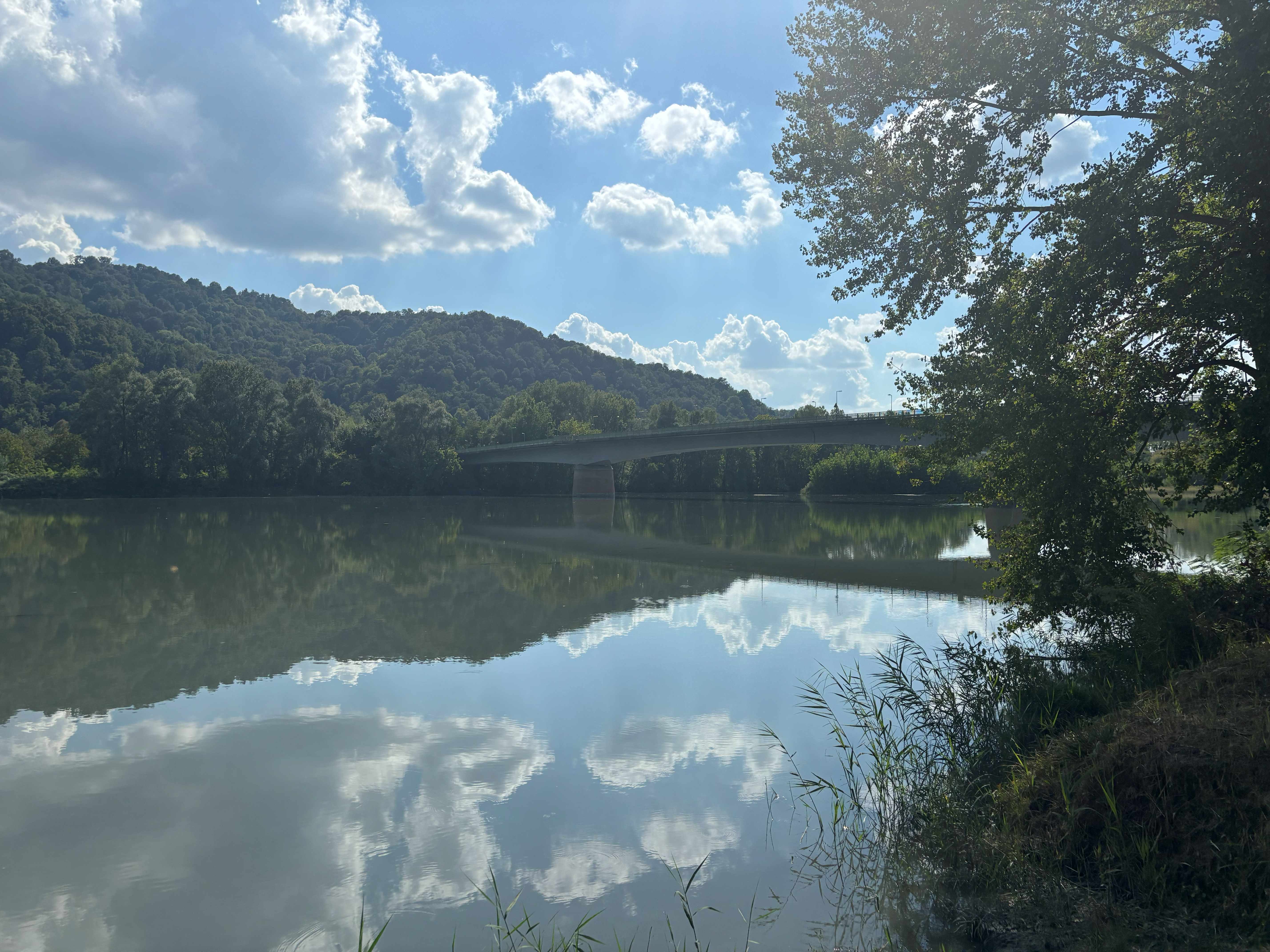
The river Po at Chivasso
After walking a few hundred metres, I arrived at the river Po, which is looking surprisingly full. Passing through the riverside park, I find the entry to the Cavour Canal, which as mentioned above allowed the widespread exploitation of rice cultivation in the plains of Vercelli. It was a Vercelli land surveyor Francesco Rossi who in the 1840s first conceived of the construction of a canal . In his plan the canal would have originated from the Po at Crescentino. That project was abandoned, possibly because the route would have crossed the land owned by the Count of Cavour, but the idea was maintained. In 1852 the work was entrusted in 1852 to the engineer Carlo Noè by the then president of the Council of Ministers of the Kingdom of Sardinia, Count Camillo Benso di Cavour. Carlo Noè's project envisaged the canal much further upstream at Chivasso which would allow it to irrigate a much larger portion of the plain, including the middle Vercelli, Novara and Lomellina, even if the canal now had to cross two large rivers, the Dora Baltea and the Sesia. Carlo Noè's project was approved by the Italian Parliament in 1862. Its actual construction took place at the instigation of the ministers Quintino Sella and Gioacchino Pepoli between 1863 and 1866, after the proclamation of the Kingdom of Italy and the death of Cavour, and cost approximately 45,000,000 lire..
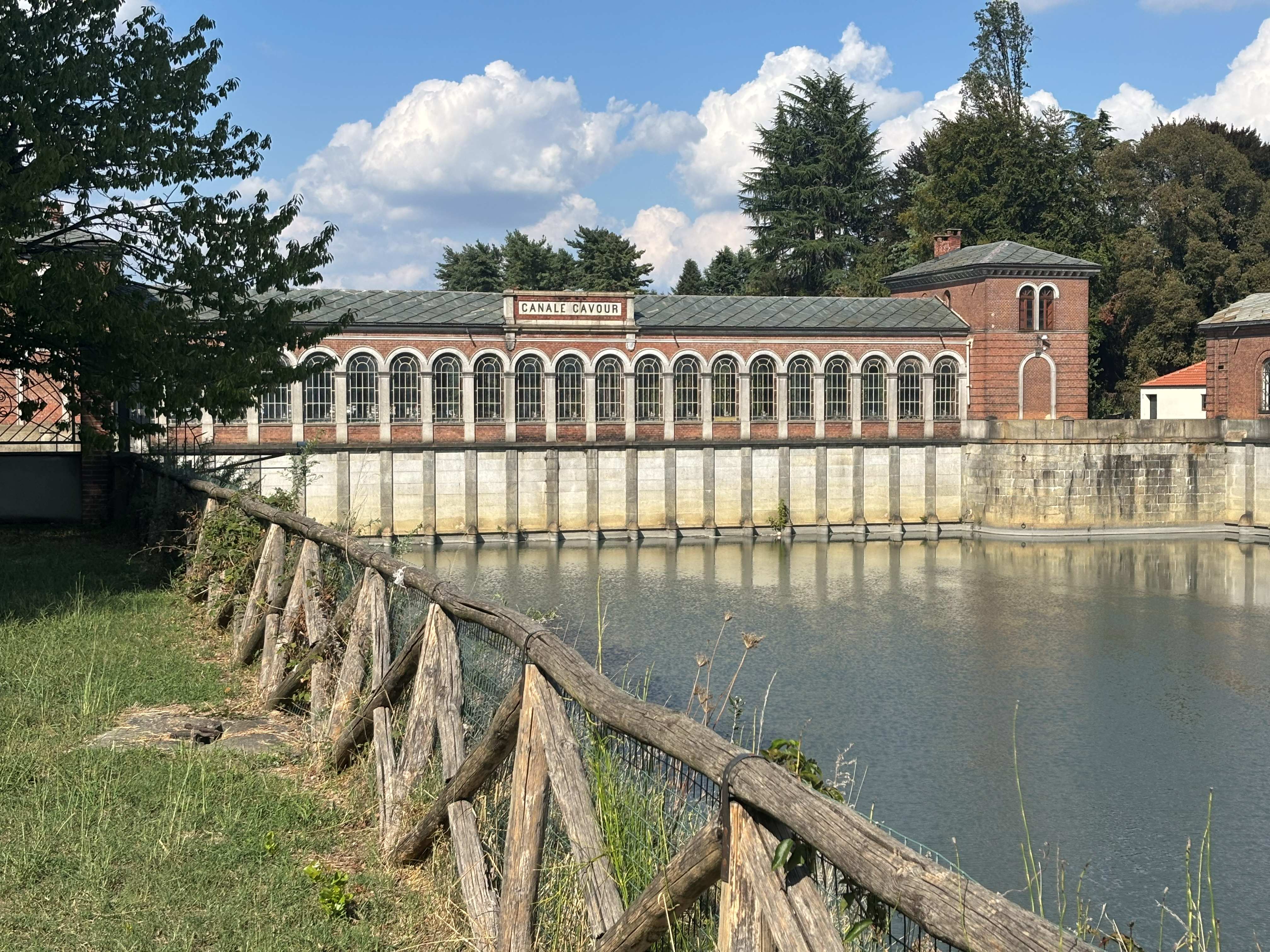
The entry to the Cavour Canal
The Cavour canal is a spectacular work of hydraulic engineering with 101 bridges, 210 siphons and 62 canal bridges were built for the crossings of roads and waterways... The inlet of the canal is located about 200 meters east of the Chivasso bridge on the hydrographic left of the river, about 400 meters downstream of the road bridge that connects Chivasso with the hill. The intake mouth, 40 meters wide at the bottom, is paved for the first 460 meters with pebbles and concrete and for the last 40 meters, closer to the intake building, with stone and concrete slabs. After about 600 meters you will come to the entrance key, or the building that houses the sluice gates intended to regulate the flow of the canal. A short spillway channel located upstream of the sluice gates allows the return of excess water to the Po.
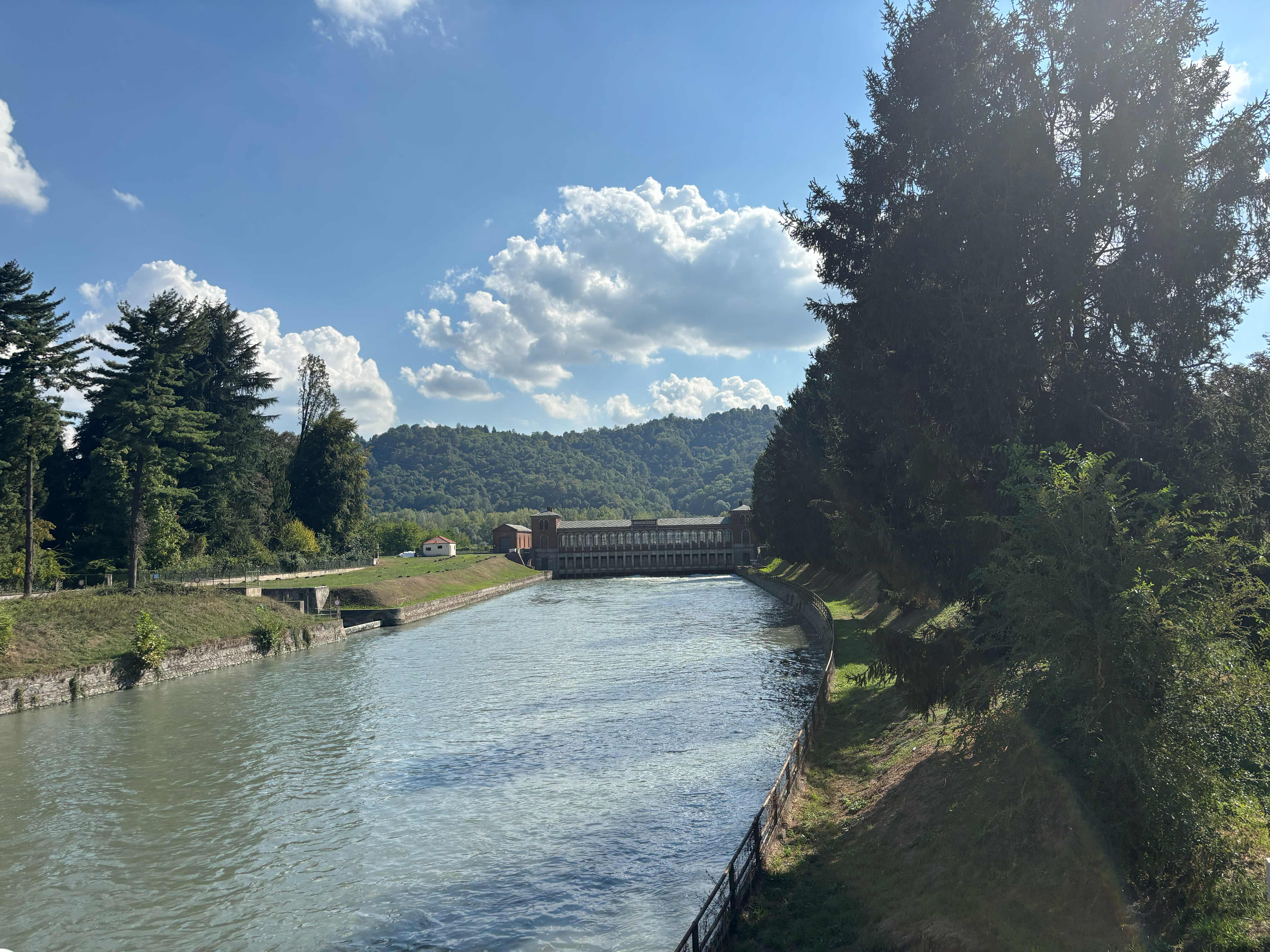
Another view of the Cavour Canal
From Chivasso, I head up the branch line to Ivrea. Charles Henfrey also contracted for the Chivasso and Ivrea Railway. The Turin to Novara railway included a stop at Chivasso, however the city of Ivrea was excluded from the network . Thomas Woodhouse presented a project for a 32-kilometre-long line which, starting from Chivasso, would pass through Caluso and Mazzè and, after touching the shores of Lake Candia, would reach Strambino and then Ivrea. The plan was accepted with some variations according to the lobbying of towns on the route.
By Royal Decree of 14th June 1856, Thomas Brassey and Charles Henfrey were entrusted with the concession to "build and operate a railway from Ivrea to Chivasso, assuming the commitment to all their expenses, risk and danger, and to complete it within 20 months from the date of approval of the law". The Società anonima della ferrovia di Ivrea was established with a capital of four million lire, represented by 8,000 shares of 500 lire each, half of which were subscribed by the concessionaires. work began in September and proceeded quickly, even if an extension of one year was necessary, granted by the Ministry of Public Works also to complete the two most daring works: the bridge over the Chiusella, with 5 arches of 14 meters each, and the Caluso tunnel 251 meters long. On May 22, 1858, the section from Chivasso to Caluso was inaugurated and the inauguration of the line between Chivasso and Ivrea took place on November 10, 1858. The inaugural train departed from Turin Porta Susa bearing Prime Minister Camillo Cavour, the Minister of War General Alfonso La Marmora, Charles Henfrey and other personalities.
The line starts from Chivasso at 184 m above sea level and a first climbs gradually reaching the highest point at Caluso at 281 m, before descending and finally reaching Ivrea at 238 m above sea level. In 1858, the Evening Mail reported on the opening of the first stretch from Chivasso to Ivrea:
“The beautiful valley of Aosta, less visited by travellers than it deserves to be, is probably the richest mineral district in the continental dominions of the King of Sardinia. It has important mines of iron and copper and also produces some anthracite coal. Hitherto it has been isolated in respect of railways, and the expense of transport of its produce, and of the up-carriage of fuel, has been a drawback upon the prosperity of its forges and upon the development of its mineral wealth. The first step towards the removal of this disadvantage was taken on Thursday last by the opening of the first half of the line of railway now in course of construction between Chivasso and Ivrea. Chivasso is a town of 7,000 or 8,000 inhabitants and is the first important station on the line of rail from Turin to the Ticino. It is due south from Ivrea, and the new railway takes a very direct course northwards. The portion opened to the public on Thursday was from Chivasso to Caluso. The train which left Turin at 8 in the morning conveyed Mr. Charles Henfrey, one of the contractors, some of the railway official authorities, and a large number of guests invited to the opening. It was met at Chivasso by a train which left Caluso at 7.55. A junction of forces having been effected, the numerous party — which included, notwithstanding the interest of that day’s sitting of the Chamber, some Deputies and various persons of mark — started for Caluso, stopping at the intermediate stations of Montanara and Rodallo, at each of which, as at Caluso, they were received with discharges of mortars. At the last-named place a collation awaited them under a marquee, and the company passed part of a fine day in strolling in the adjacent country, which is very pretty. On debouching from a short tunnel of 200 or 300 metres, at Caluso, a most beautiful view meets the eye. The peasants from the country beyond, many of whom had probably never seen a railway, came trooping down in considerable numbers, expressing, in their singular jargon, a naïve admiration and astonishment, and giving some trouble to keep them from under the wheels of the carriages. A number of sindacos, or mayors of the villages adjacent to the line, had been invited, with their adjoints and secretaries; and a very quaint-looking lot of authorities they were, some of them decorated with the St. Helena medal, of which a large number have been claimed and received in this country by old soldiers of Napoleon. The line to Ivrea, which is being executed by Messrs. Brassey and Henfrey, (the acting engineers being Messrs. Dixon and Dent,) is, it is hoped, only the commencement of a more extensive one which will traverse the Valley of Aosta, pass through a tunnel under Col Menou, and terminate in Switzerland, at a short distance from Martigny, in the Valais. Turin would thus be in communication with Switzerland by about 90 miles of rail, as nearly as I can calculate the distances. The people of the Valley of Aosta are very anxious to get this project carried out, and I understand have already had the studies made for the 75 kilometres, or about 50 miles, from Ivrea to the place where the Menou tunnel would open. There are some engineering difficulties, but the estimate is that the road might be made for 18,000,000f. or 20,000,000f., or 16,000l. a mile. In England, where there has been so much lavish and even reckless expenditure on railroads, this will appear a very moderate rate, but it is less so in a country where a good deal of railroad has been made at the cost of little more than 6,000l. a mile. That to Ivrea will cost, I believe, something less than 8,000l. per mile, and will be not unlikely to pay five or six per cent., even without prolongation to Aosta. But Aosta is a large town; the traffic in the valley is considerable and on the increase, and the prolongation will doubtless be accomplished, probably at no very distant period. It would be a great point to get the rail up to the vicinity of Aosta. When that was done, the communication with Switzerland would hardly be long delayed. I have not been able to ascertain the exact length of the proposed tunnel under Col Menou; it would be some kilometres long, but I am assured that it does not by any means come, like that of the Mont Cénis, in the class of exceptional and unprecedented undertakings, of doubtful issue. When the line to Ivrea is completed, however, it will be but a short step into the lovely Valley of Aosta, to which the number of visitors will doubtless increase. Already omnibuses are being established to run between Caluso and different places in its neighbourhood.”
From Ivrea the line continued to Aosta. The whole stretch is now closed while being electrified and is replaced by a notorious “Rail replacement Bus “. Anyway that’s ai idea for a future ride . From the Station at Ivrea, the line to Aosta crosses the river Dora Baltea on an iron bridge and then heads into the tunnel. At the time of writing in September 2026, there are still major works going on there. Which prevent easy access to the old town of Ivrea.
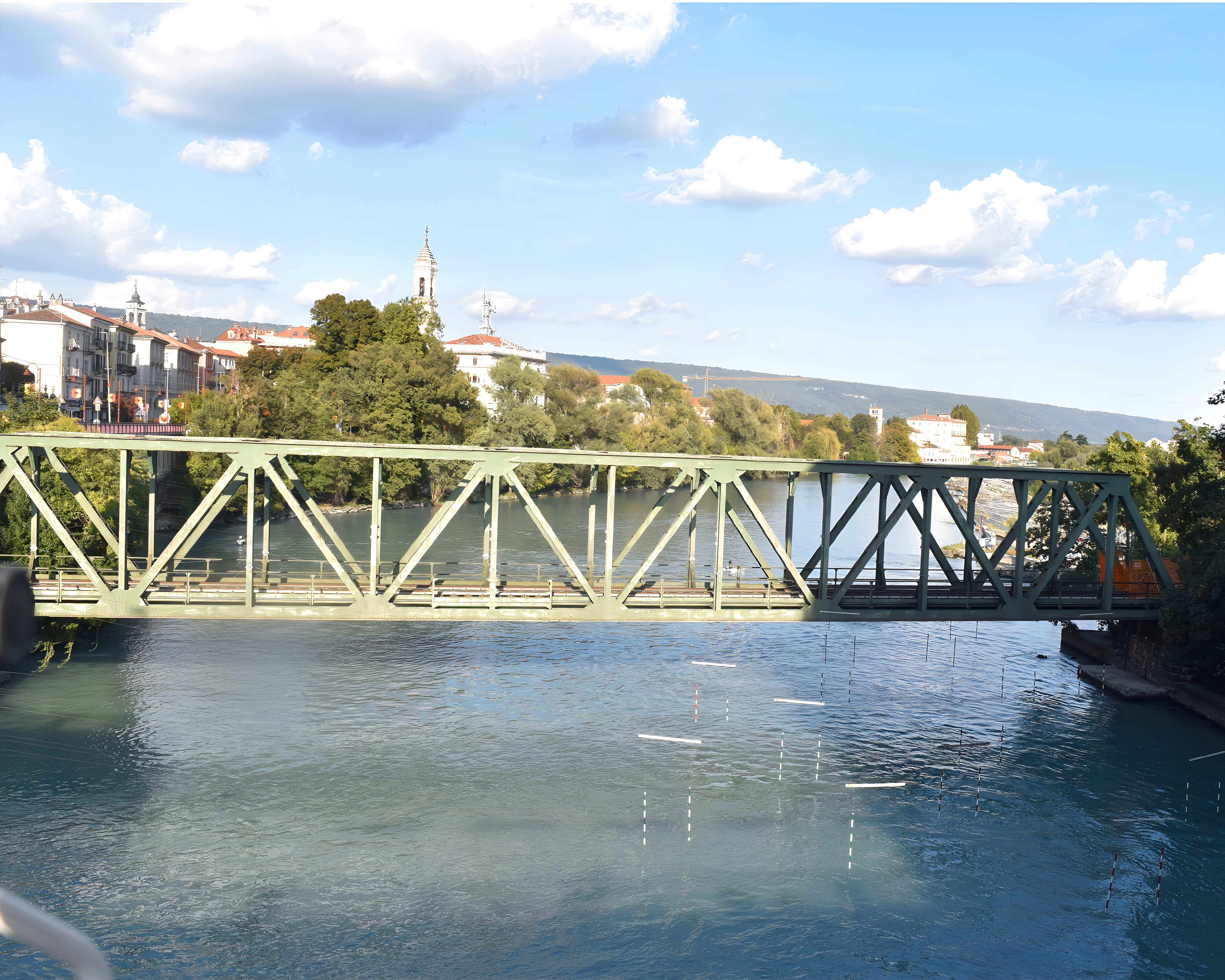
The bridge at Ivrea which carries the railway towards Aosta- unfortunately in 2026 closed for upgrading
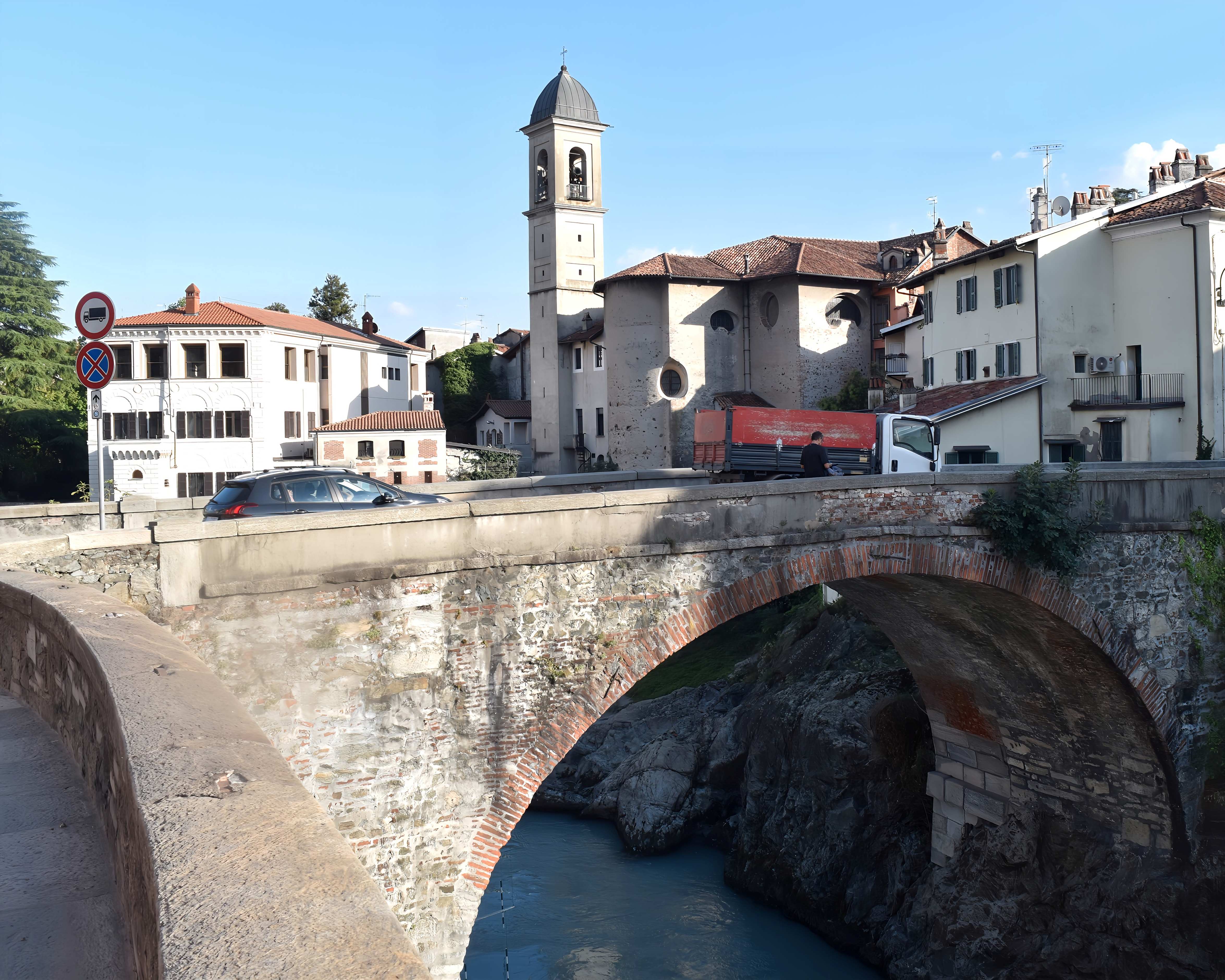
The old bridge in Ivrea
Ivrea la bella che le rosse torri
specchia sognando a la cerulea Dora
nel largo seno, fosca intorno è l’ombra
di re Arduino
Ivrea is located at an altitude of about 267 m above sea level, not far from the entrance to the Aosta Valley. It is bathed by the Dora Baltea river, a tributary of the Po, and is located in an area formed by a large Pleistocene glacier, which transported over time numerous debris that went to form a series of moraines. The morainic structures, in fact, tends to form a real geological amphitheatre around the city. A strategic road crossroads already in ancient times, to the west of Ivrea it is possible to reach Valchiusella, while to the north the Valle d'Aosta region. To the east the road to Vercelli and Milan branched off. To the northeast, the one to Biella. The historic centre of Ivrea climbs up a hill that leads to the Savoy Castle and the Cathedral, while the modern part extends on the plain, occupying both banks of the Dora Baltea and the surrounding territories.
The city was founded around the fifth century BC by the Salassi, a people of Celtic origin who settled in the Canavese area. Starting from the first century BC it was in fact a Roman colony, placed to garrison the military road that from the Piedmontese plain went into the valleys of the Dora Baltea. In the Lombard period Ivrea became the seat of the duchy of the same name[. At the beginning of the ninth century, Ivrea became a county and march, under the Frankish kingdom, through the nascent Anscarica dynasty. After a period of conflict with Warmondo, the powerful bishop of the city, in the year 1000 it was acquired by the Marquis Arduino da Pombia, who the following year was elected Rea Pavia by a diet of princes and lords against the will of Emperor Otto III of Saxony. The city acquired great importance within the Kingdom of Italy. In the second half of the twelfth century, the political power of the marquises of Monferrato tried to assert themselves, who established the territory of the "municipality of Ivrea and Canavese", destined to succumb in the first decades of the following century. In 1238, Emperor Frederick II placed the city under his rule; later the lordship of the city was again disputed between the bishop of Ivrea, the marquis of Monferrato, the Prince of Achaia and the count of Savoy. In 1356 Ivrea passed under the dominion of the Green Count of Savoy. In the second half of the fourteenth century the city witnessed the peasant revolt against the abuses of the Canavese nobles which goes by the name of "tuchinaggio". With the exception of brief periods of Spanish and then French occupation in the sixteenth century, Ivrea remained under the Savoy for practically the entire period between the fifteenth and eighteenth centuries. On May 26, 1800, Napoleon was welcomed in Ivrea together with his victorious troops. Under Napoleonic rule, Ivrea was the capital of the Département de la Doire, one of the five into which Piedmont had been divided; however, in 1814 the city, as well as the rest of Piedmont, returned to the Savoy. The twentieth century saw the city as the protagonist of the birth of an industrial Center, with the foundation in 1908 of the Olivetti typewriter factory
The railway returns from Ivrea to Chivasso where it is possible to continue towards Turin or return to Milan by way of Vercelli.