In Search of the Fell Mountain Railway ; Part Two " On Mont Cenis"
In part one, we went in search of the Fell Experimental Site in the Goyt Valley. Having established his proof of concept in the High Peak , Mr. Fell needed a more stringent test to convince the French and Italian governments that his project was going to work in the rather more challenging environment of Mont Cenis. It seems to have taken a while , but by February 1865 John Barraclough Fell was installed at the grand sounding Hotel Imperiale in Lanslebourg, a village around 2,000 feet from the summit of Mt. Cenis. Having seen ,at least what we think is the test track of the Fell Railway in the Goyt Valley , a couple of years later I set off in search of the test track on Mont Cenis.
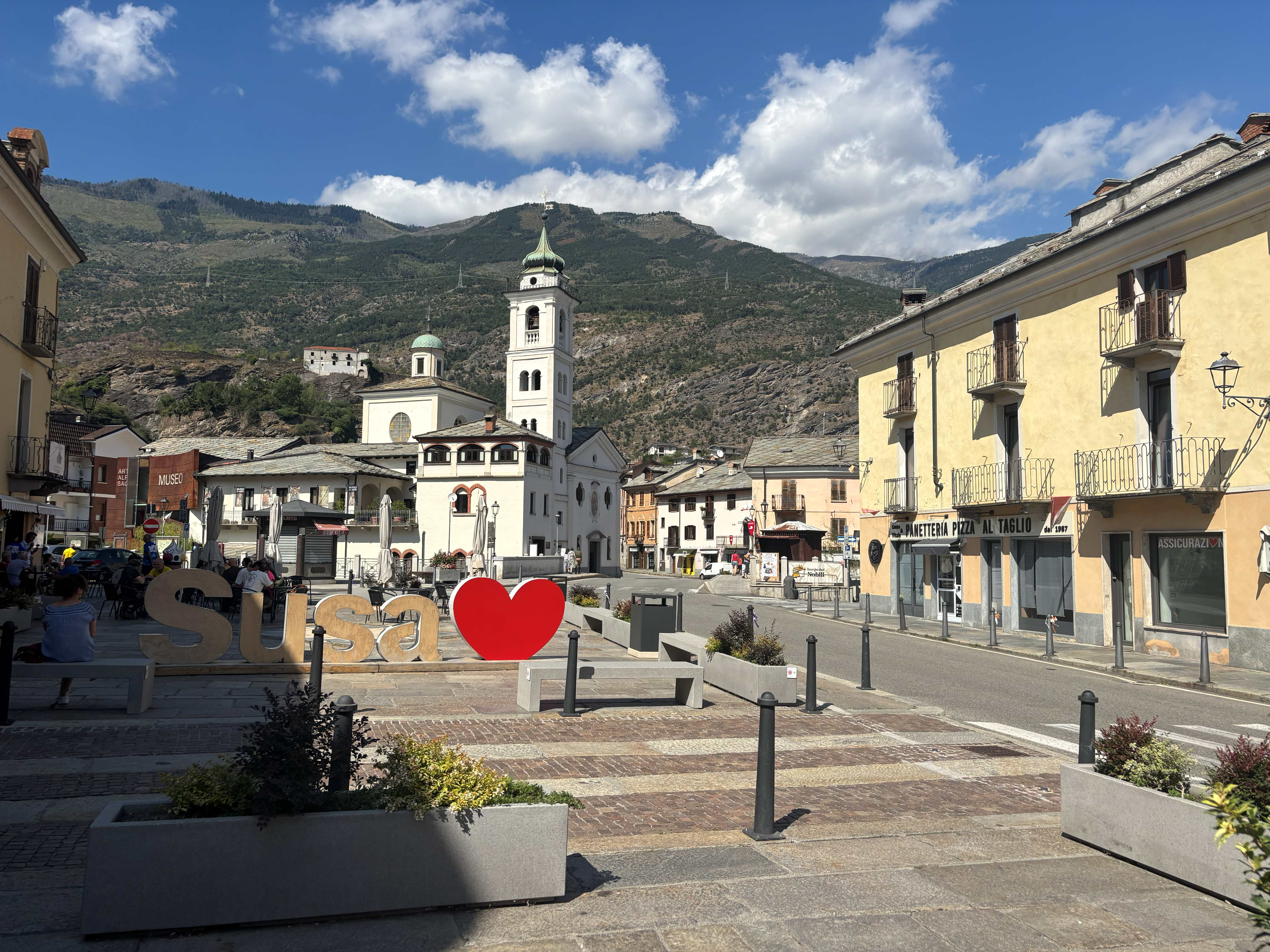
I was staying in Susa on the Italian side, at the appropriately named “Fell Hotel” , a modern and comfortable establishment. I travelled from Turin to Susa along the route of Jackson, Brassey, Henfrey’s Turin to Susa railway. Although it is only 53km, the electric train appeared to move incredibly slowly, stopping at all the stops which the British had constructed along the way, until finally we reach Susa station. While the original objection that the railway station in Susa was too far from the centre of town, seem to have been correct, it had apparently allowed a more modern version of Susa to develop around the railway station.
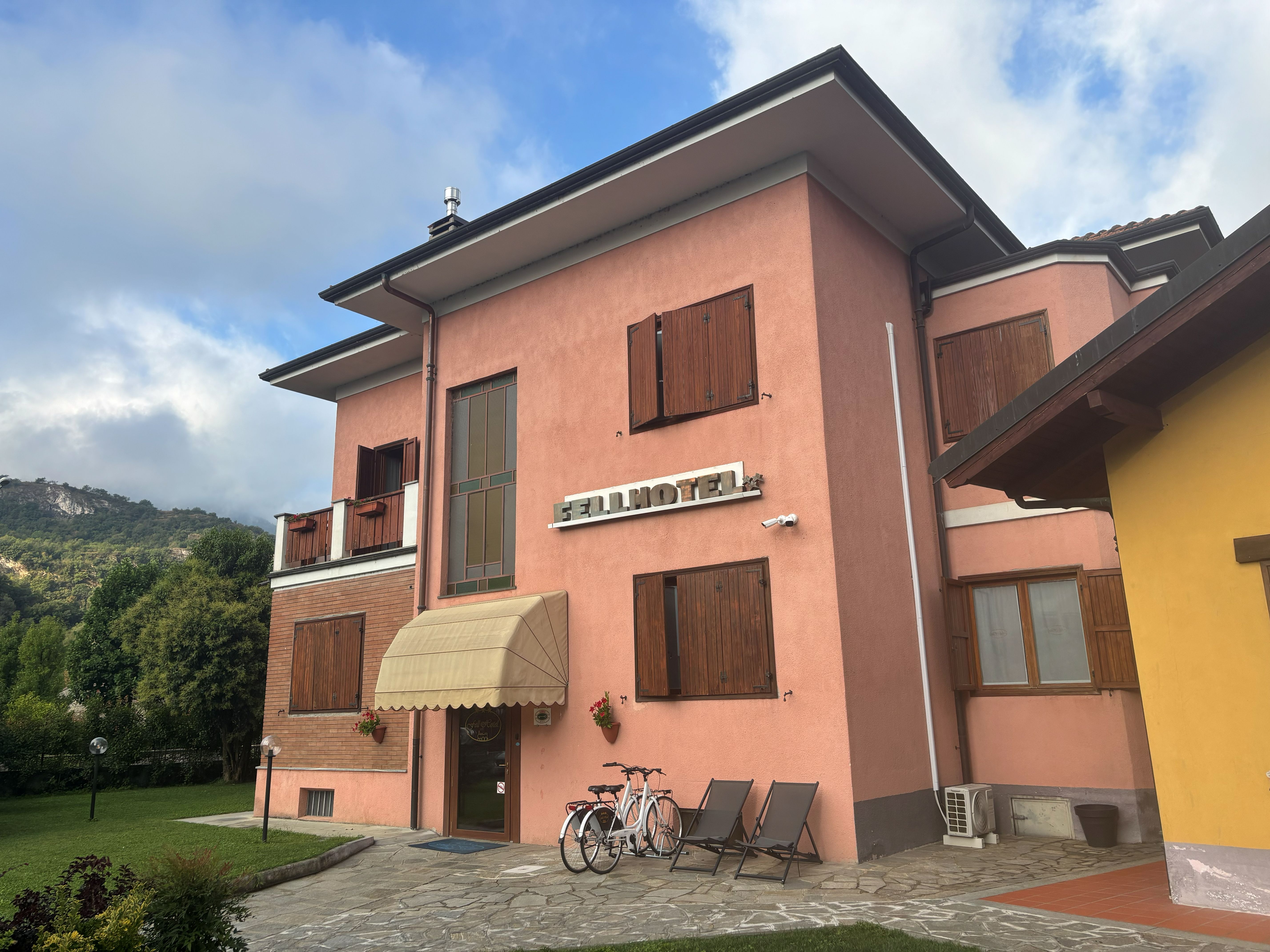
The Fell Hotel Susa. Although it looks a bit modern for Mr Fell to have stayed there
The illustrated London News was not so complimentary when describing Susa in the 1860s
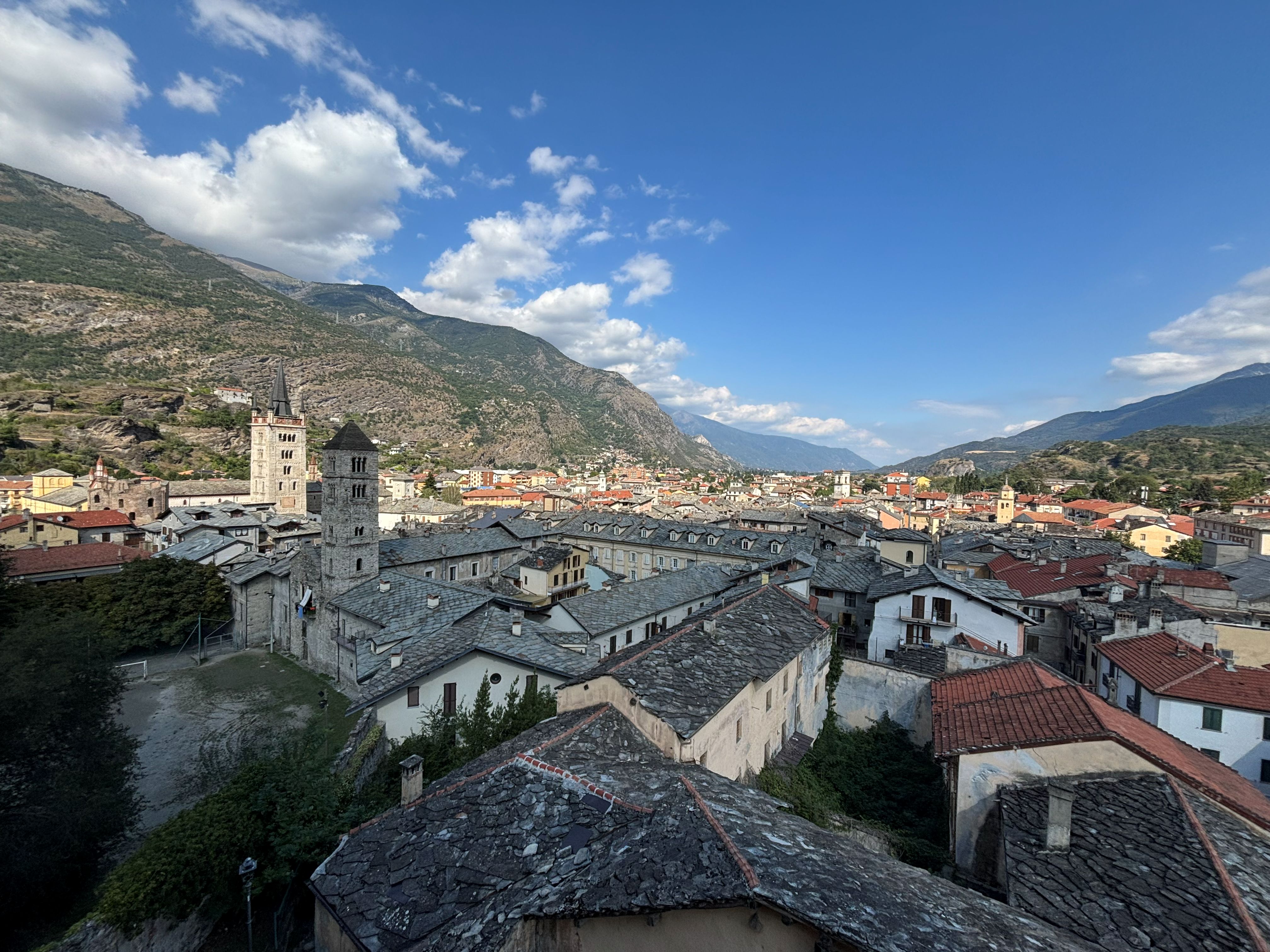
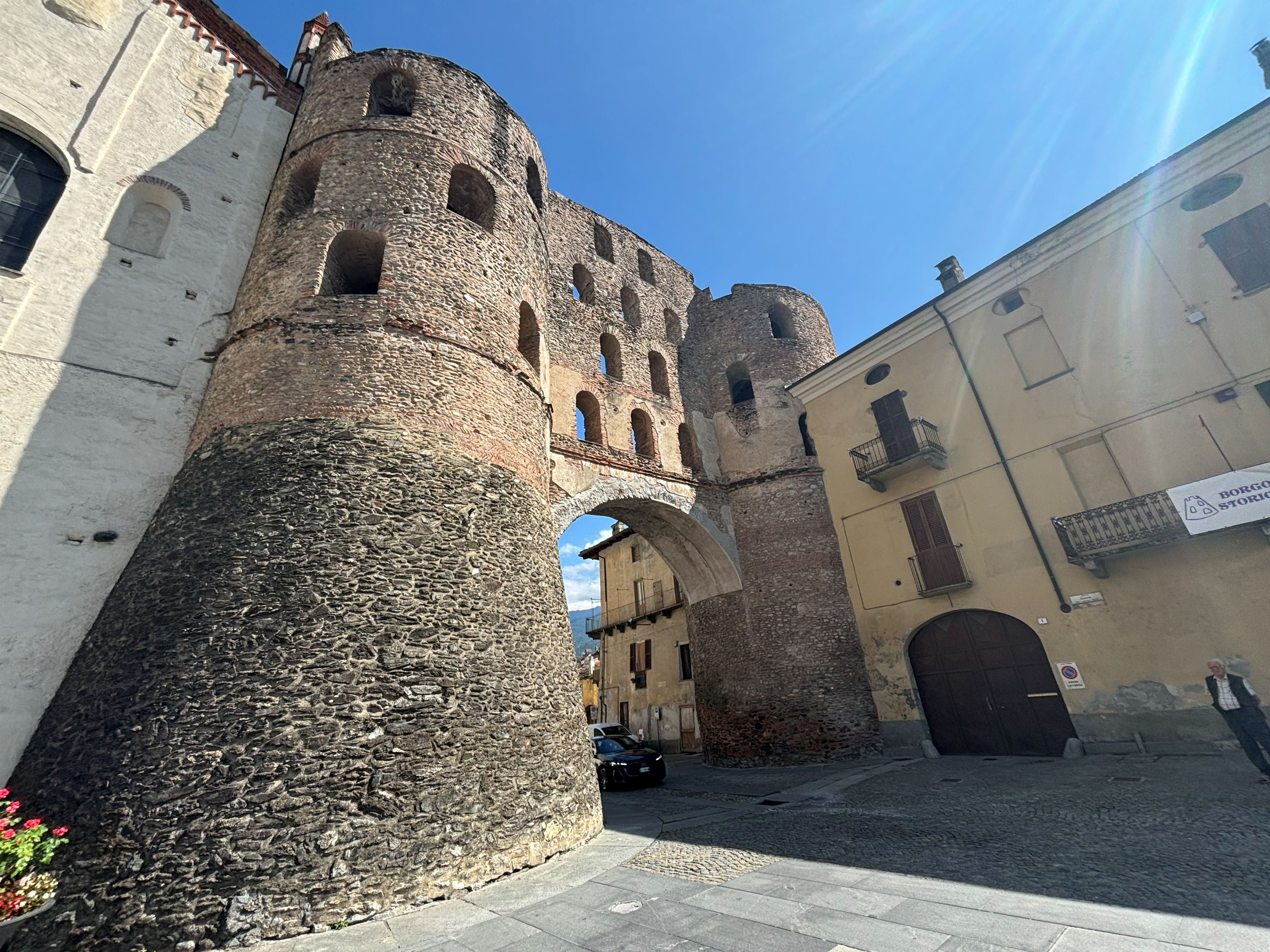
“The situation of Susa, at the entrance of the mountain gorge, and on the banks of the Dora which flows int the Po at Turin, is very striking ; but the town is poor and decayed . The principal object of antiquity is the Arch of Caesar, in marble. It is of the Corinthian order and has suffered but little from time . Some of the volutes of the capitals have been broken , , but that is nearly the extent of its dilapidations. The frieze is a mass of figures all round . They are seen leading bulls to sacrifice : It has evidently been intended as a gate to the castle which is seen , in oUr vie , behind the arch. The castle of Susa retains little of what must have been its grandeur in former times. At present only here or there is a wall and a ditch. It must have been an important stronghold , for Susa is one of the principal doors between Italy and France , and its castle must have been looked to as a sentinel to guard the pass. Many conquerors have passed up the valley of the ancient Segusia; even the Turks are said to have been here. And the place has been many times destroyed ,and indeed ruins are plentiful enough on the heights around. It is the see of a Bishop ; and there isa very old cathedral, the west end of which is a very curious and very ancient gateway with two towers flanking it, “
For a few weeks in the summer there is a naveta ( bus service) across the pass , it is heavily subsidised by the French and Italian local authorities to encourage local people to cross the border. The bus also has a large bicycle rack, to carry bicycles up to the summit for those who don’t want to cycle up, but who would like to cycle down.
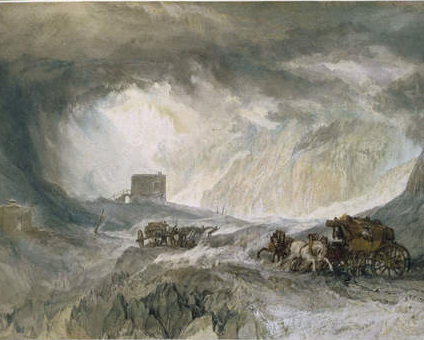
JMW Turner's " Snowstorm on Mont Cenis". crossing in a dilgence might take 12 hours"
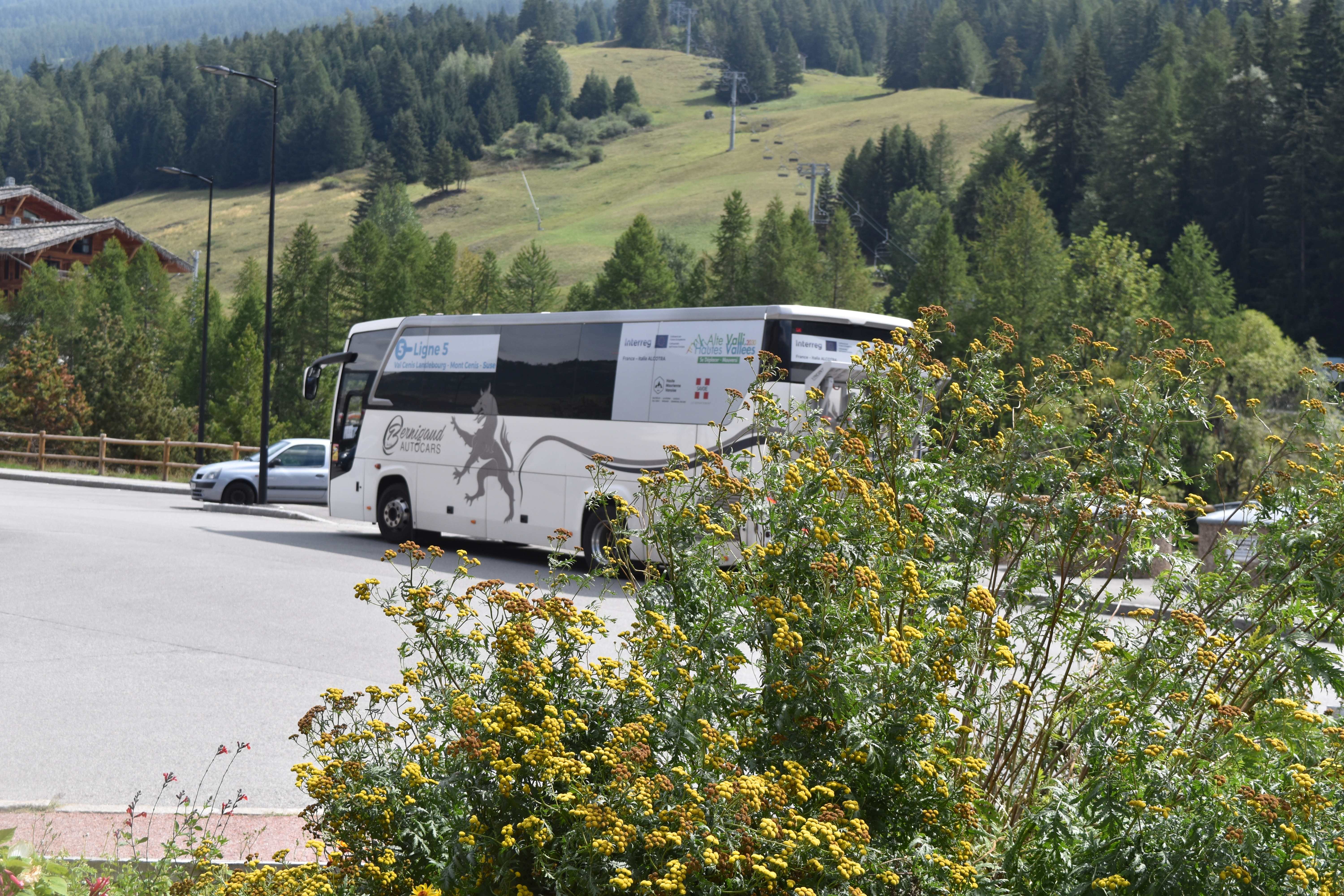
These days the bus takes about an hour and a half.
The bus pretty much does the whole route from Susa to Lanslebourg . Leaving from the railway station in in Susa, it drives along the Corso Inglaterra (which then becomes the Corso Francia( and heads out of Susa as the S25,
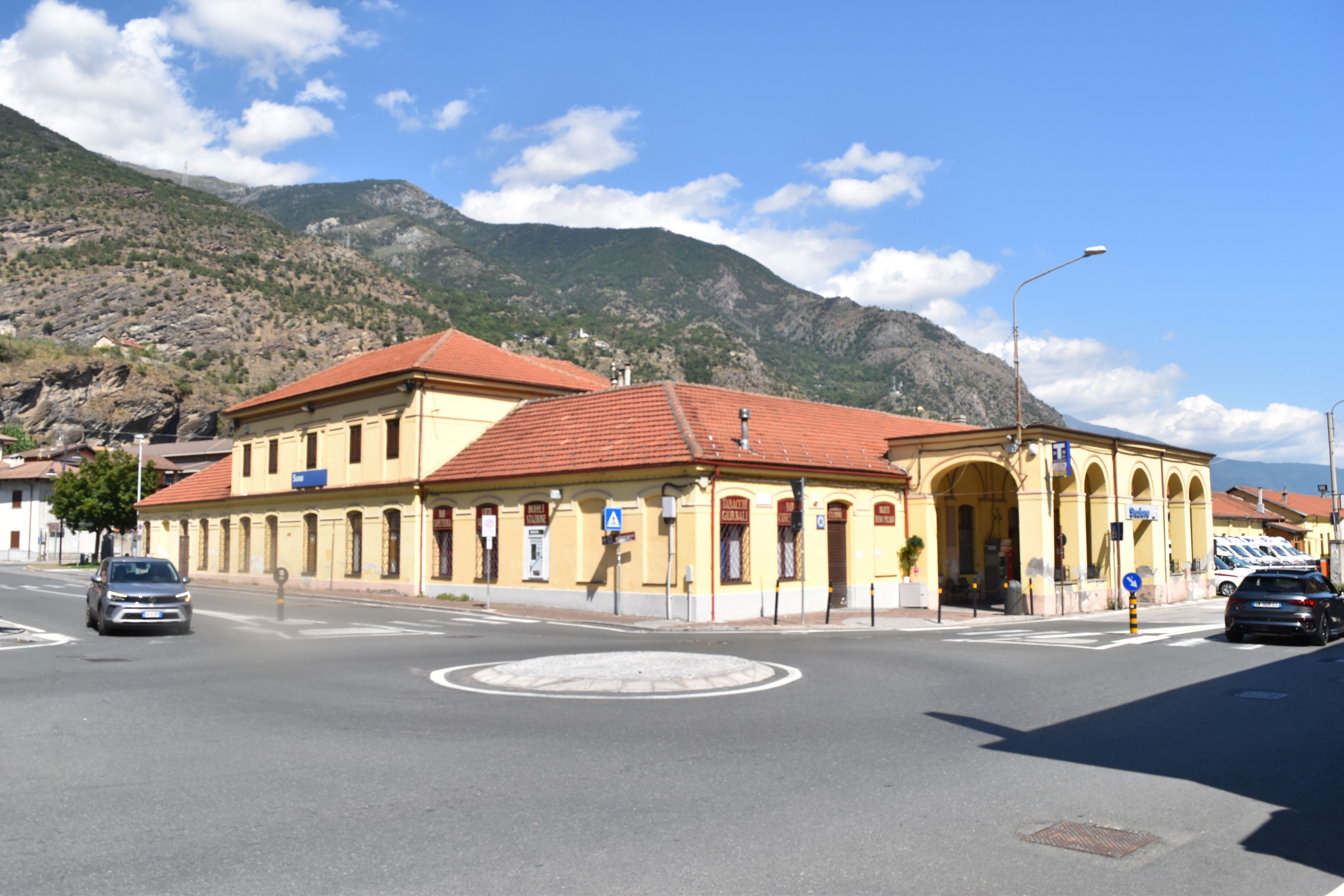
Susa railway station the end of the line for the Mont Cenis Railway in Italy. Here passengers could transfer to the British built Turin to Susa line. That line is still running. The bus over the mountains stops here.
it then begins to climb steadily, passing by and then crossing over the Autostrada A32, before skirting Giaglione and heading up in a series of impressive hairpins until it straightens out a bit , but continues its steep ascent .
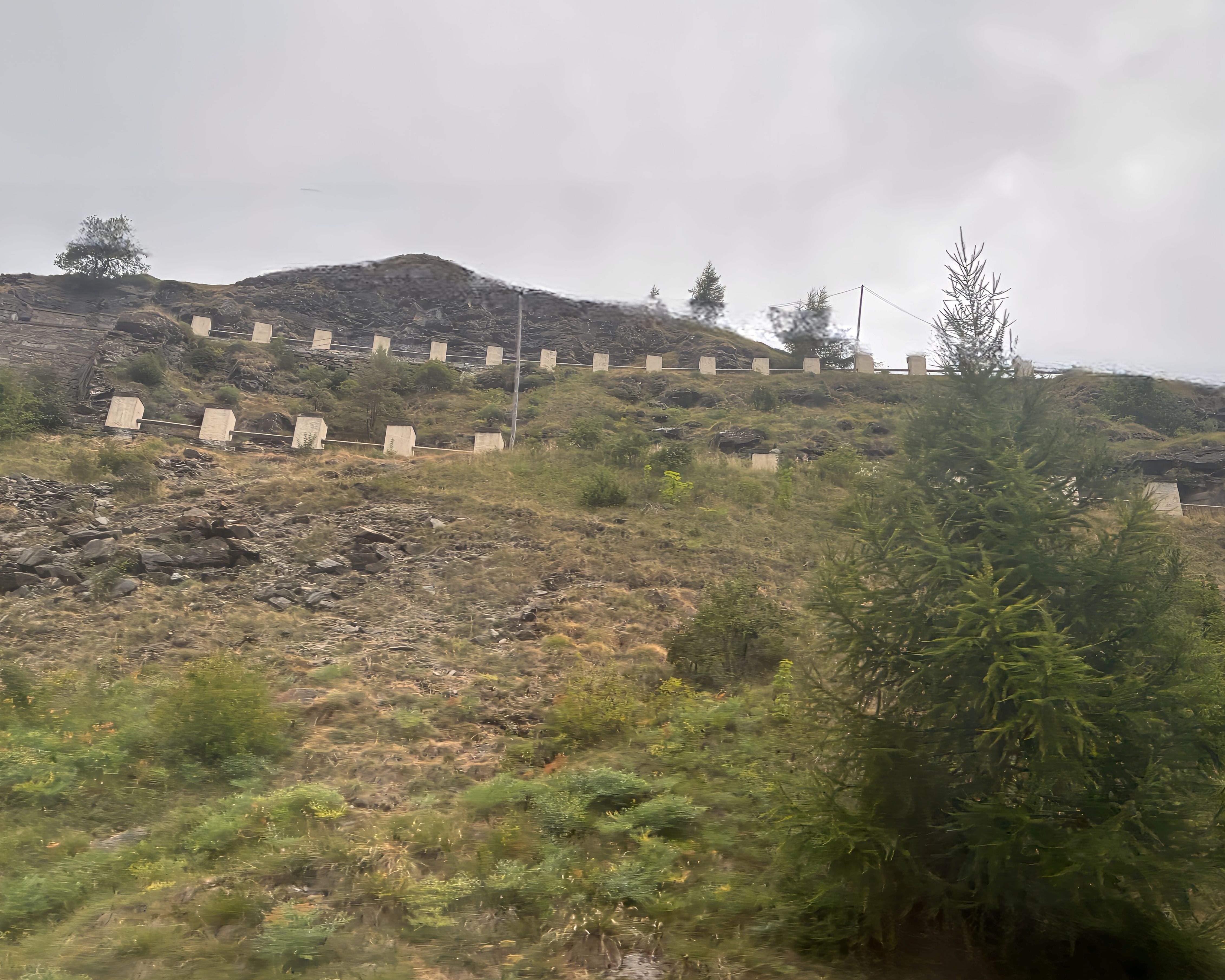
Some steep hairpins on the way up from the Italian side
We have now left the tree line behind , and are on open plateau with some stunted looking trees which soon give way to grasses and heather. It looks not unlike the Goyt Valley . Above the tree line, it is pretty bleak, the clouds are low and the sun is not reaching the Mont Cenis plateau. At just beyond Piana di San Nicolo it reaches the French border. Until 1945, the French border was on the other side of Mont Cenis, but the French annexed this part of Italy sat the end of WW2 and it became French for good following the Treaty of Paris in 1946. In France the road becomes the D1006, after a fairly straight stretch , it ten embarks on another even more scary series of hairpins before heading along Lake Mont Cenis. There was the risk of avalanches on this side of the mountain and one can still see the masonry enclosed galleries that would have protected the train from that risk, Although still in evidence ,they look pretty small and it is hard to imagine he train passing through them, or the smokey conditions inside the tunnel when it did.
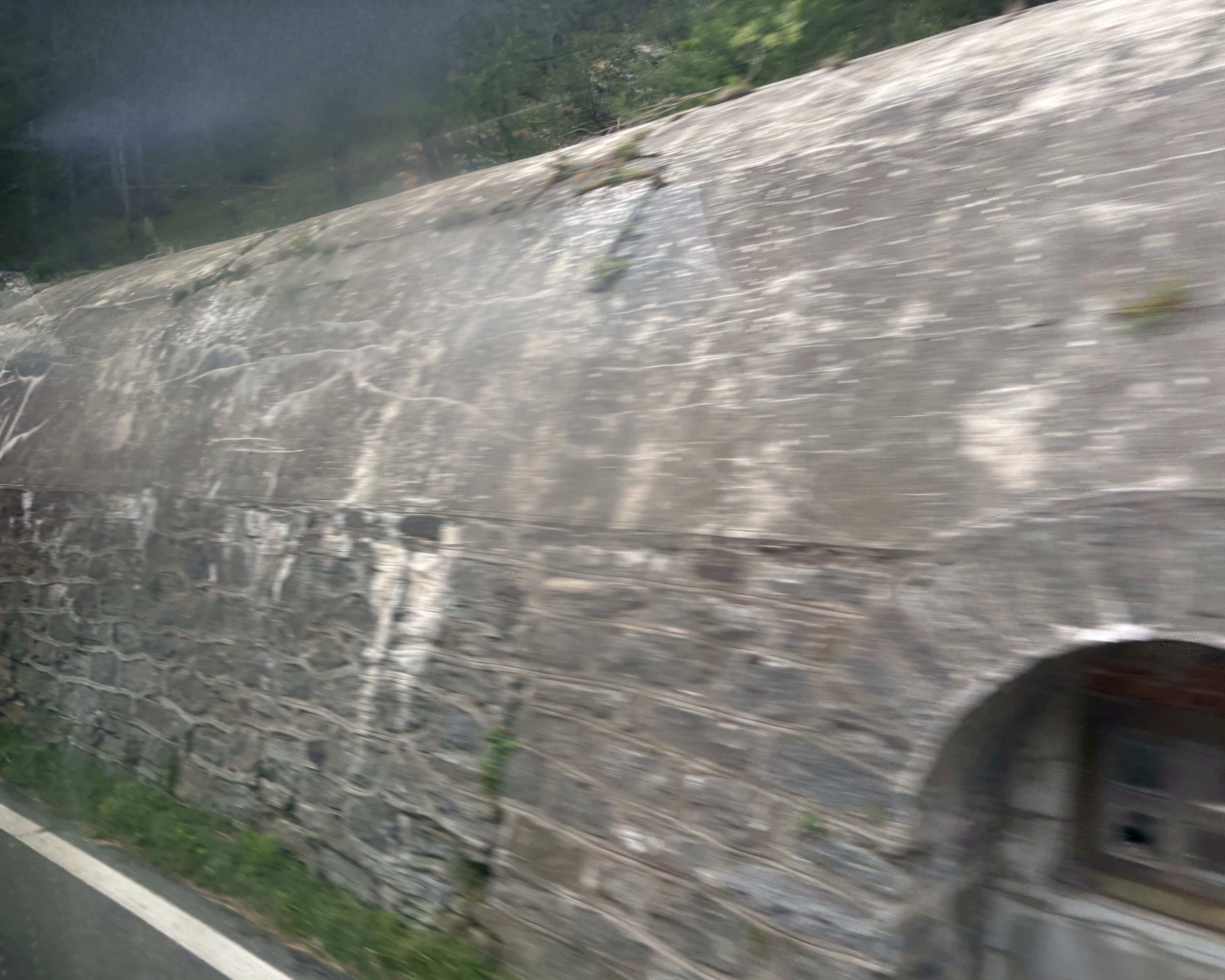
In parts the Monte Cenis line was covered by tunnels to protected from avalanches
Lake Mont Cenis a former natural lake which has now been converted into a reservoir by EDF. Here are a few restaurants up there at Plain des Fontainettes . If I wanted to I could leave the bus and have a wander around, but the weather is not good, there is little to do and I would have to wait for three hours for the next bus, so I head directly to Lanslebourg. We pass the Col du Mont Cenis at 2081 m. After that it is back below the tree line and downhill all the way, through some more gentle zig zagging hairpins before a gentle final run into Lanslebourg.
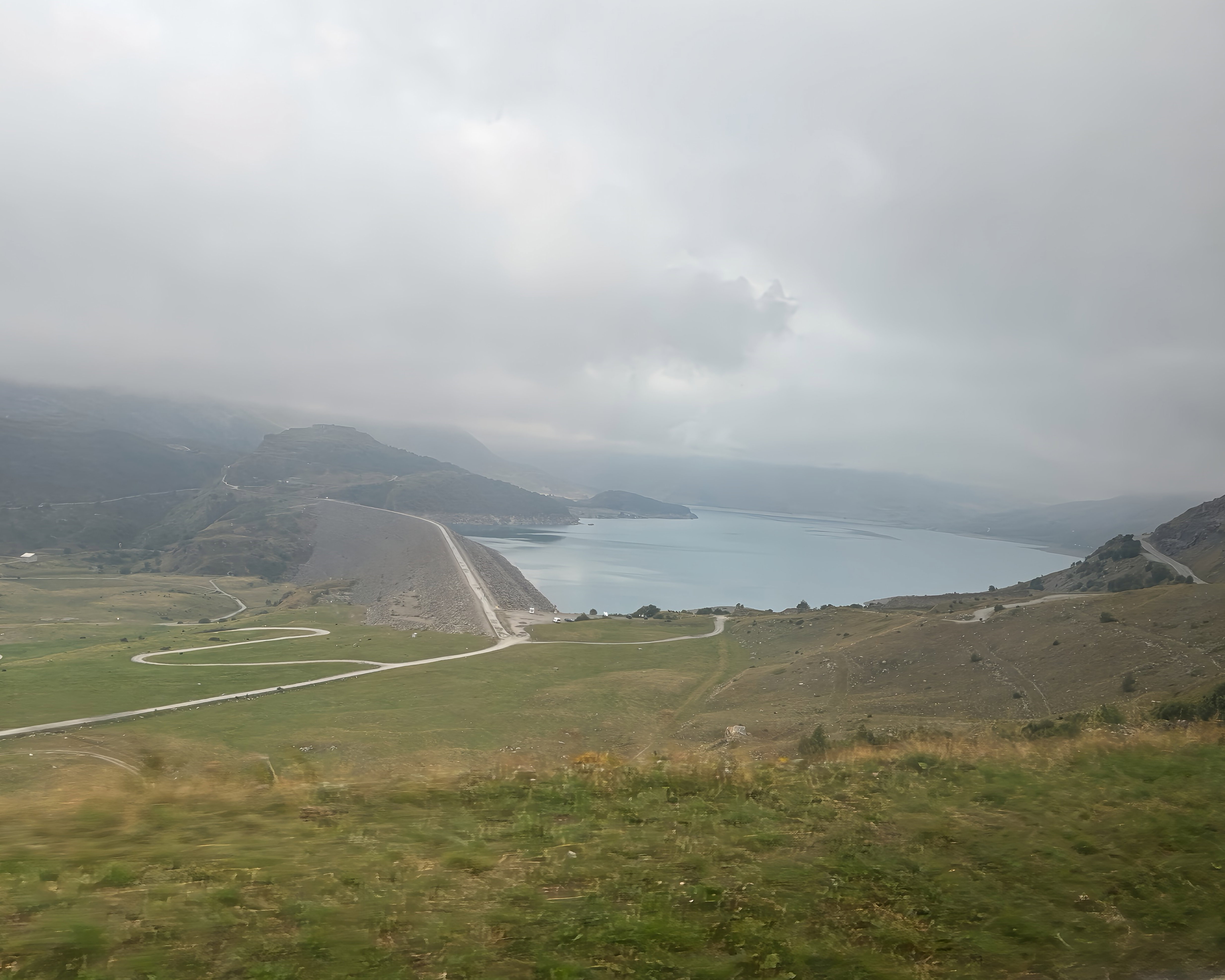
Lac Mont Cenis
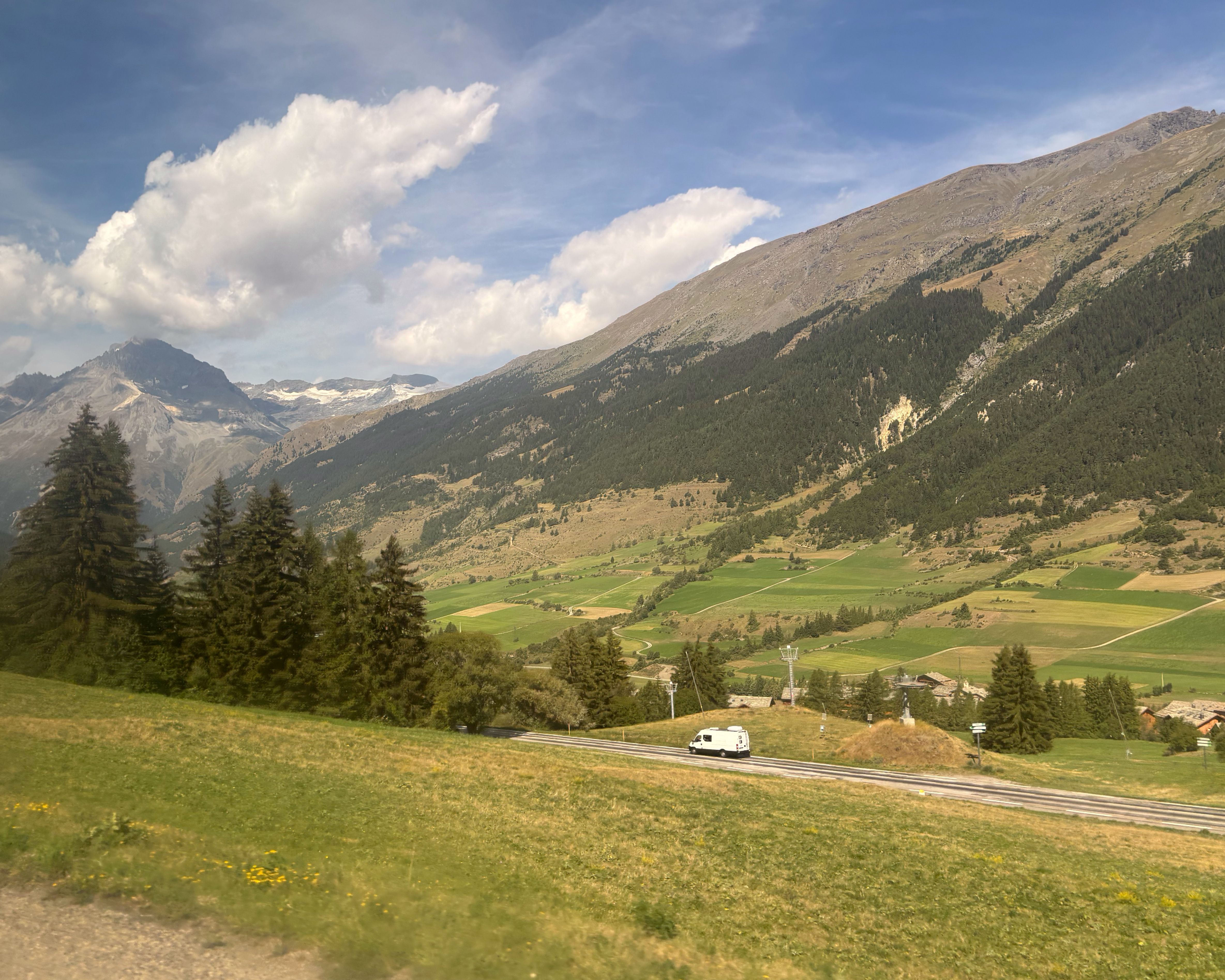
The descent to Lanslebourg
Lanslebourg must have grown considerably since Mr fell was in town. Back in the 19th Century, it was famous as a frontier town, the last stop before Italy. The locals made a living as muleteers, waggon driers and guide for the vital commerce heading over into Italy. The bus stops at the Auditorium, a rather handsome and modem building which sems to include the Tourist Office , The offices of the Ecole Ski de France for the winter season and a cinema, Nearby is the equally modern headquarters of the Gendarmerie for the area. In the winter Lanslebourg must be a bustling ski resort, although fairly quiet on a Monday in late August, the main road is full of modern hotels and ski shops. It is all quite tastefully done . Further down the main strret in Lanslebourg is the older part of town, there are two older churches, Plus there is an interesting reference to the Route of the Turin Shroud . The shroud was originally acquired by the House of Savoy in 1453 and housed in their capital at Chambery , before being taken to Turin, Did it pass through Lanslebourg on the way, possibly ?. There is also a small display of local history, which does mention the Fell Railway.
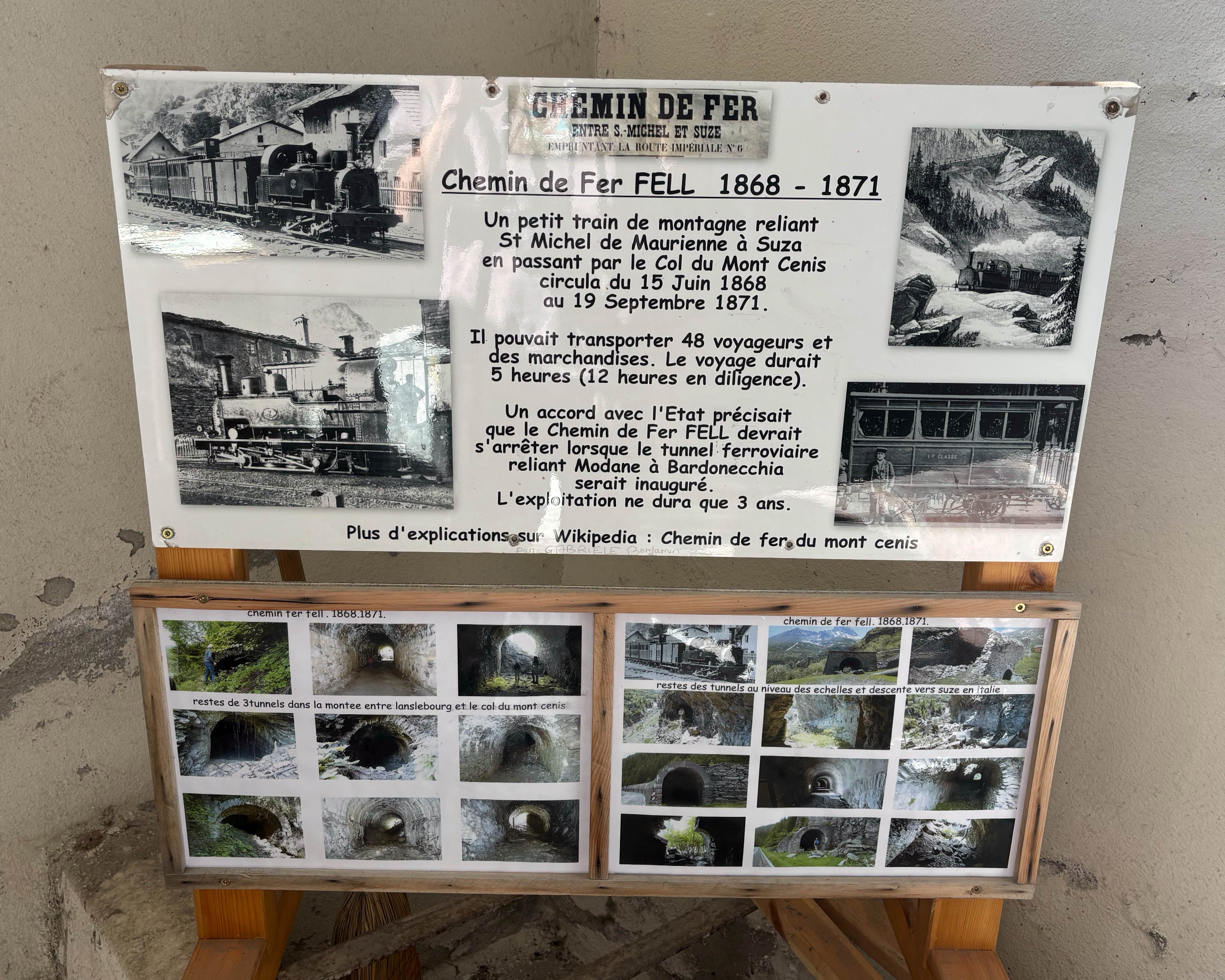
A small exhibition on the Fell Railway in Lanslebourg
The Hotel Imperiale seems no longer to exist, which is probably a good thing since it was described as “ comfortless “ but with good views, other accounts mention a Hotel Royal. Possibly it upgraded itself following Louis Napoleon’s coup d'état. The hotel also served as a base for French Customs Officers..The Gendarmes now have a new and comfortable looking base of operations, in alpine style. The choice of hotels is much better these days. Since it was lunchtime, i thought i would try and sample the famous Mont Cenis Trout , which i did at the Relais des 2 cols, a menu fixe with a starter of Tarte de Beaufort and then the Truite followed by tarte aux myrtilles proved to be excellent.
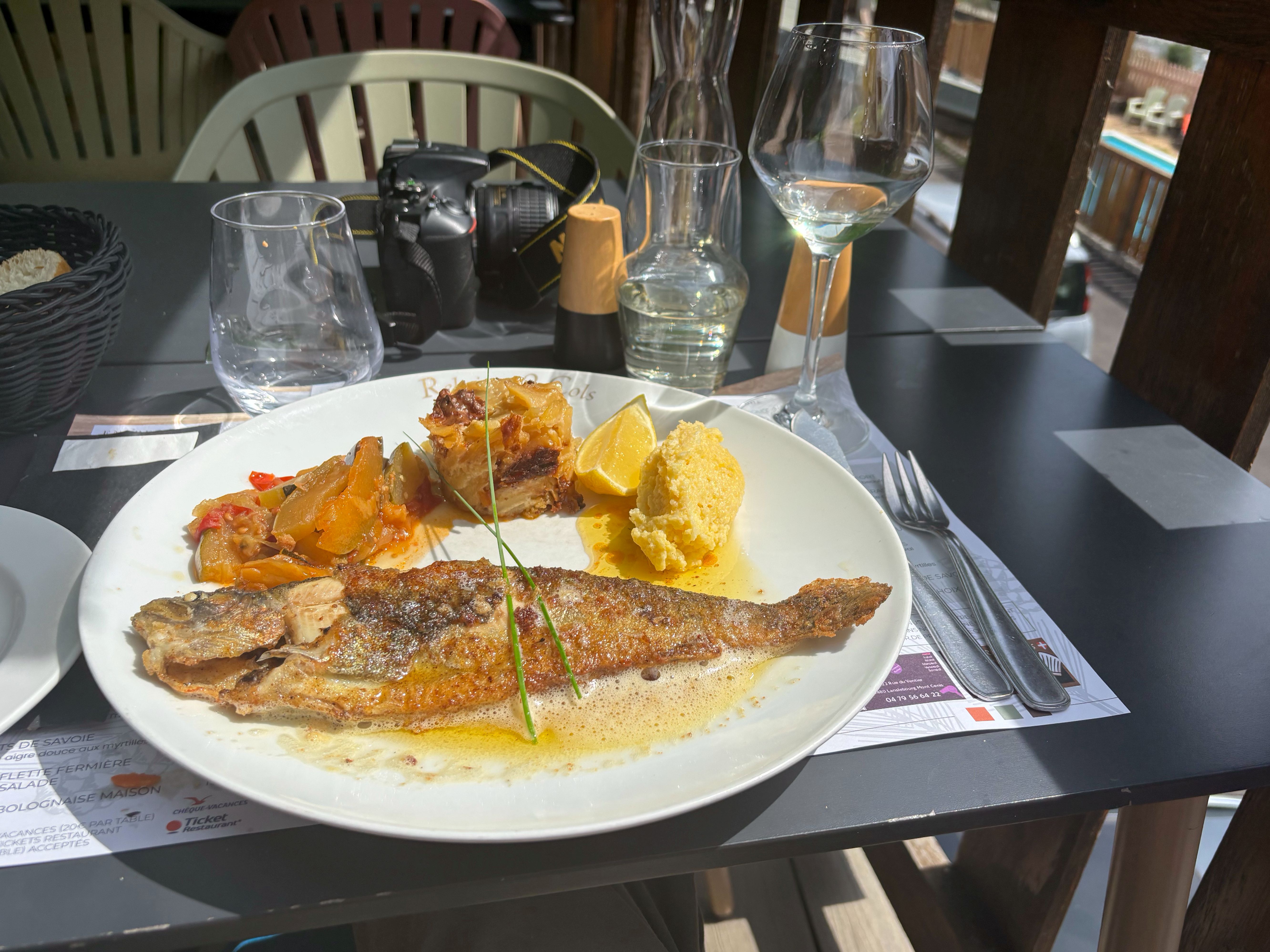
Trout from Lac Mont Cenis
Fell carried out his first test on 28 February of 1865, notwithstanding that there was still snow on the ground. The location of the experimental line had been designated by the French and was laid down between Lanslebourg and the summit, commencing at the height of 5305 feet above sea level and terminating at the elevation of 5820 feet. Since the village of Lanslebourg is at 4200 feet the test track must have been some way up the Napoleonic road. Unlike the Goyt Valley , there was no existing railway nearby, which begs the question how on earth they got the locomotive and carriages up all the way from the nearest railway at St Michel and half way up the mountain. The locomotive itself weighed around 14 tons. It is a pity that there are no apparently no accounts of this, so one can only assume that at a considerable number of horses must have been involved. Two horses in tandem could potentially pull 14 tons of wheeled vehicle, but ion the flat. Presumably it needed teams of several horses and the shill of the muleteers to get the locomotive to where it was needed. Unfortunately nobody has ever covered that part of the story, It was difficult but not impossible, looking back sat an earlier piece on the Milan to Monza railway, that managed to ship a British built locomotive all the way from Genoa to Milan, being pulled by horses.
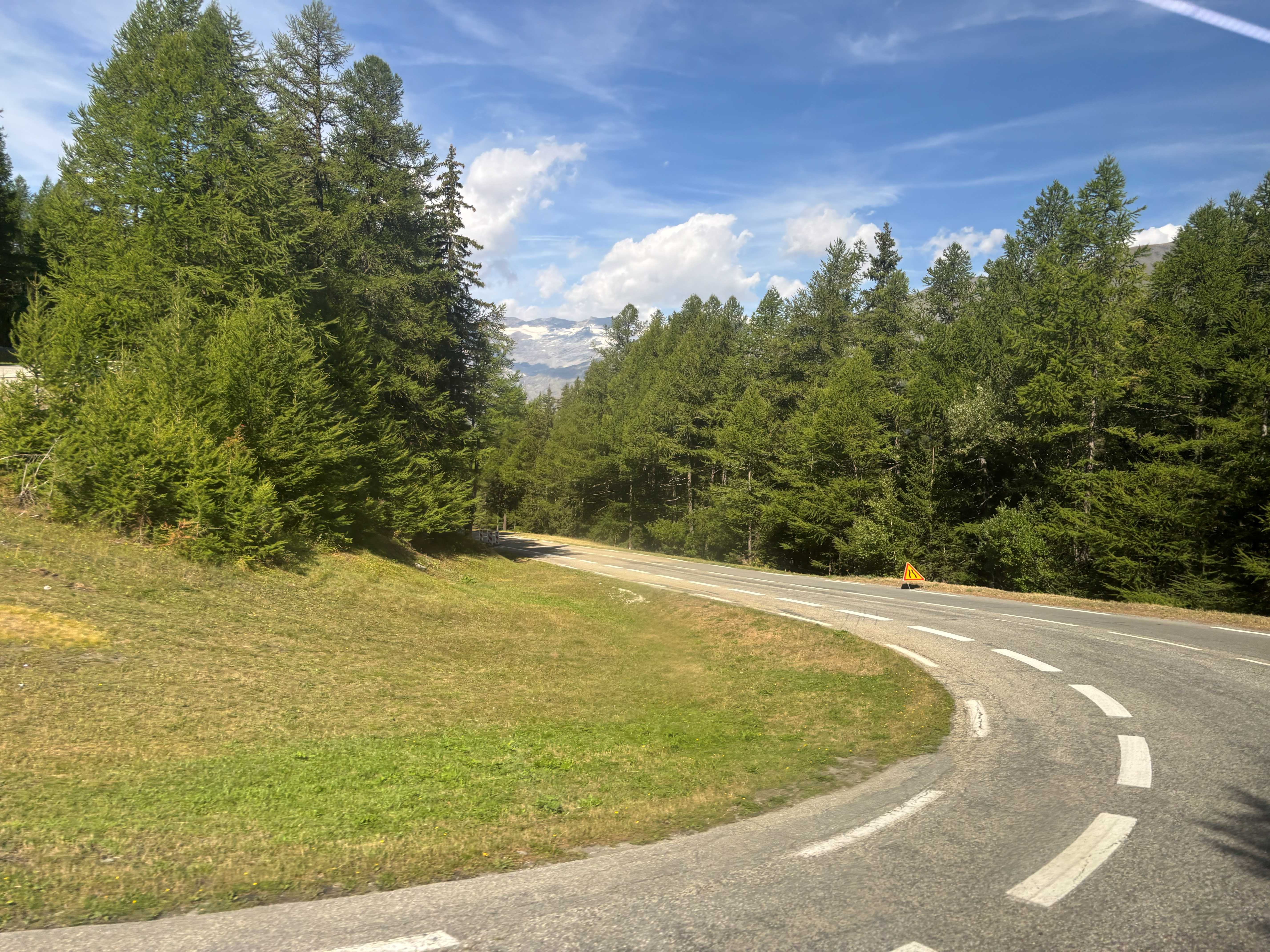
On the way down. Somewhere near the location of the test track
The test track was two kilometres (a mile and a quarter) long. Gauge, 3 feet 7/8 inches. Its mean gradient was 1 in 13, with a maximum was 1 in 12 ; it had two curves of 44 yards each, and others, the most favourable of which was 125 yards. It was thus fairly similar to the experimental test site in the High Peak, if about 4,800 feet higher. As regards gradients and curves, the route was designed to subject the system to the severest tests. The experiments, which were conducted in the presence of commissioners from England, France, Italy, Austria and Russia, lasted from the end of February until July 1865, the adhesion was found to be better during the period of snow than in summer. When the snow was swept off the rails, it left them dry, and under favourable conditions ; whereas, in the summer dust combined with moisture, rendered them comparatively greasy and slippery.
Captain Tyler RE, who was present at all the experiments on the part of the British Government, calls special attention to this curious fact in his report. A former officer in the Royal Engineers, . Tyler was later appointed an Inspecting Officer for Railways in 1853—at the time a function normally carried out by Royal Engineers officers. In February 1866, by now an expert on railways Tyler was seconded to government service with the Board of Trade , and he was taken off the strength of the army. In 1866, he was sent to inspect the Italian railway systems of for The Board of Trade, in order to determine how best to transport the Indian Mail. Although he was there as an expert on behalf of the British Government, Tyler seems to have lent his considerable expertise to making a few practical suggestions for improvements to the Mont Cenis railway. It may be fashionable to deride experts these days, but Captain Tyler knew his business and reported on test;
“ As the results of my observations and experiments, I have to report, in conclusion, that this scheme for crossing the Mont Cenis is, in my opinion, practicable, both mechanically and commercially, and that the passage of the mountain may thus be effected, not only with greater speed, certainty, and convenience, but also with greater safety than under the present arrangements. Few would, in the first instance, either contemplate or witness experiments upon such steep gradients and round such sharp curves on the mountain side, without a feeling that much extra risk must be incurred and that the consequences of a fractured coupling or a broken tire, or a vehicle leaving the rails, would on such a line be considerably aggravated. But there is an element of safety in this system of locomotive working which no other railway possesses. The middle rail not only enables the engine to surmount, and to draw its train up these gradients, but also affords a means of applying any required amount of extra brake power for checking the speed, or for stopping any detached vehicles during the descent, and it further acts by the use of horizontal guiding wheels on the different vehicles as a most perfect safeguard, to prevent engines, carriages or waggons from leading the rails, in consequence either of defects in the bearing rails or of failure in any part of the rolling stock. The safest portions of the proposed railway ought indeed, under proper management, to be those on which, the gradients being steeper than 1 in 25, the middle rail will be employed. “
The French Imperial Commission present at Lanslebourg, consisted of M. Conte, ingenieur en chef des Ponts et Chaussees de France, as President, with Messrs. Bochet, ingenieur en chef des mines, Guinard, ingenieur des Fonts et Chaussees, and Perrin, ingenieur des mines, as his colleagues. They completed an extensive report of thirty-one pages, accompanied by drawings, with the following conclusions :
“ From the experiments which have been described, and which the Commission has judged unnecessary to continue any further, and from the different verifications which it has made, the Commission has arrived at the convictions : ……That the system of traction proposed by Mr. Fell is applicable for the passage of Mont Cenis, with the engines of the type which worked at the last trials…that this system presents no danger as regards the public security on steep inclines and on sharp curves, since, on the contrary, the existence of the centre-rail furnishes a guarantee against getting off the rails, and at the same time a powerful means of stopping the trains. …..there is no absolute incompatibility, in consequence of the vicinity of the railway and the ordinary road, one to the other, provided that proper protective works be erected to effectually separate them.”
The final French test was held on 18 July 1865 . It proved a great success. The Italians would conduct their own independent tests, which commenced on 26 July, in the same place. Having concluded these tests, obviously the French and Italian bureaucrats and legislators then went on holiday for the whole of August. These days the British investors would have been able to disturb their holidays to check on progress, but in 1865 they just had to wait.
By the autumn of 1865, the French and Italians had returned from their holidays and had the opportunity to digest the reports of their respective experts. It turned out that Fell had an ally in the French emperor, Napoleon III. Napoleon who was , of course the nephew of Napoleon Bonaparte who had original ordered the construction of the Mont Cenis road. Louis Napoleon had been the democratically elected president of the French Republic, until his term ran out and he staged a coup d’état to stay in powe.He was a convinced modernizer, whose regime had seen a massive expansion of the French railway system . Apparently the Emperor was already of the opinion that increased adhesion, and thereby increased power, would be obtained for engines, by the adoption of a third or centre rail, along the sides of which additional wheels would be run.
On the 4th of November, 1865, Napoleon, par la Grace de Dieu et la Volonte Nationale, Empereur des Francais, authorised, by Imperial Decree, the construction and working of a locomotive line between St. Michel and the frontier of Italy (the summit of the pass) until “ the opening of the tunnel of the Alps ’’ for traffic. The decree was accompanied by a Cahier des Charges (Table of Conditions), setting out the obligations of the concessionaires , Messrs Brassey Fell et Cie. This was followed by acceptance on the Italian side. The convention obliged Brassey, Fell and Company to construct at their own cost and risk the railway. Brassey ,Fell had deposited 6000 lire as a guarantee.
The railway was to be located on top of the existing road, possibly on the part towards the valley or the river, leaving free as an ordinary road, six metres ( 18 feet ) of which five ( 15 feet ) metres for the road and one metre ( 3 feet ) for the footpath .Where exceptional conditions prevailed and it was not possible to preserve the ordinary road , the footpath could be reduced. The railway would be a single track of between 3 and 4 metres separated from the road with a solid barrier capable of resisting animals and vehicles. it would also be covered as a defence against the snow in a places thought to be necessary . The company was also required to make sure that the walls supporting the road were sufficient to also support the railway or take the necessary remedial action. After opening the company was responsible for maintaining and keeping the railway in good order.
For operations the convention also specified the rolling stock and carriages which could be used , including detailed specifications on the disposition and furnishing of first, second and third class carriages . Further clauses specified the maximum speeds of operation permissible. There were also detailed instructions on the fares to be charged, who could be carried for free and so forth. The concession would finish on the day in which the Mont Cenis Tunnel opened or thirty years , once the concession was ended, the concessionaires were required to remove all the equipment , rail tracks , barriers and basically put the road back to normal. If the concessionaires did not start work within 6 months of being granted the concession, they lost all their rights to the concession as well as the 6000 litre bond that they had provided. If if the works were not completed within two years due to the fault of the concessionaires the government could take steps to convert it back into the road.
The British with their interest in the Indian Mail continued to keep a watchful interest over developments on the Mont Cenis pass. By 1866, Tyler had travelled the length of Italy investigating the railway system and pats and had reached his favourable conclusions on the use of the Mont Cenis route for the Indian Mail.
With the concession for the railway granted, the British investors now needed to raise the cash for the construction costs, since as noted above , if work did not begin within six months Brassey, ell and the other investors would lose their 6000 Lire Bond, this now became quire urgent. Quite sensibly they ringfenced the rather speculative Mont Cenis project in a newly formed Joint stock and Limited liability company, so if the whole thing went west their other railway interests would not be threatened. The Mont Cenis Railway Company Limited was launched in a number of newspaper adverts in 1866, the abridged Prospectus for the company promised.
“ Concessions have been obtained from the French and Italian Governments for constructing and working a ;locomotive railway over the Mont Cenis, from St Michael in Savoy to Susa in Piedmont, a distance of 48 miles connecting the railways of France with those of Italy, whereby an improved route will be created from France and England to Italy, Egypt and the East, and a saving of two days effected to the transit of the Indian mail. The directors have satisfied themselves that the cost of the line will not exceed £375,000 including rolling stock , payment of interest at 7 per cent during construction , and preliminary expenses, The gross revenue produced by the existing traffic on the road, with the same annual increase as thar of the past years will be sufficient after paying working expenses and 7 per cent interest on bonds and shares to reimburse the capital and leave a profit of £253,000 at the end of seven years. But a further annual increase of 10 per cent , due to the facilities afforded by the railway may reasonably be assumed and the revenue this accruing would give the shareholders a profit of 18 percent per annum on the capital. employed, in addition to the 7 per cent received as interest on the shares until reimbursed”
The directors of the company included: Thomas Brassey, Fell, James Brunlees and Alexander Brogden who were all substantial shareholders. As evidence that some things never change or have been going on for a very long time, the Chairman of the Mont Cenis Railway Company , was Sir James Hudson the recently retired and well connected British Ambassador to Italy. Lord Malmesbury, Foreign Minister of the 1858–59 Tory administration, had described Hudson as "more Italian than the Italians themselves", and Quen Victoria expressed her displeasure at his closeness to the Italian liberal cause. .In 1863 he was offered the ambassadorial post at Constantinople but not wanting to leave Italy, he chose to retire. Remaining in Italy he undertook various business interests and became a director of the Anglo-Italian Bank, and a director of the Italian Lands & Public Works development company, which financed Milan's Galleria Vittorio Emanuele.
Finance was provided by some Blue Chip names, the Union Bank of Liverpool, Edward Blount and Company in Paris, Credit Genevois in Geneva, French’s Bank in Florence and Smith , Payne and Smith a London Private Bank. The lawyers were Freshfields and the brokers Laurence, Pearce and Sons. Edward Blount was well connected with the world of French and Italian High Finance. As a young man he had also worked as an attaché at the British Embassy in Paris and the consulate in Rome. In 1831 he returned to Paris and went into banking, ultimately founding the bank of Charles Lafitte, Blount and Co. Blount concentrated on financing railway construction, notably the Chemin de Fer -Ouest from Paris to Rouen After the reunification of Italy, Blount worked on the transfer of papal debts to the new Italian Government . He was this impeccably connected with France , Italy and railways. Despite all the big name board members, to the modern reader the prospectus seems rather scanty. These days it would be headed by dire warning about the value of investments going down as well as up, but these were the “good old days” before the EU Prospectus Directive and similar rules provided a modicum of investor protection. The modern equivalent would no doubt contain pages of charts hypothecating different rates of revenue return under multiple scenarios, full of colourful charts put together by an army of highly paid corporate finance advisors in PowerPoint. Forecasting an upside of 10% in revenue seems a little reckless with the benefit of hindsight. Strangely the abridged prospectus makes no mention of the tunnel being dug through the mountain which would have a detrimental effect on the projected revenue returns. Maybe the British simply did not believe that the French and Italians were capable of getting their act together to build the tunnel in any reasonable timeframe. Nothing about the effects of adverse weather conditions on the predicted 18% per annum revenue .Currently there is a vogue among advisory firms for Geopolitics in the boardroom. Not in the 1860s, despite having Hudson on the team the effects of a deteriorating geo-political situation between France and Germany did not seem to weigh heavily in anybody’s concerns. Not to say that the Directors of the Mont Cenis Railway Company misled their potential investors but maybe a bit more due diligence would have been in order. Sometimes regulation can be useful.
Clearly construction could not begin until the winter snows had cleared , but in the end it commenced on 1 May 1866, so the investors did not lose their deposit for the concession. It was expected that they would be finished in twelve months. Then in September 1866, France was hit by a spell of very bad weather. It rained for days on the French side of the mountain,. In August, sitting on the terrace eating trout from Mont Cenis , the river Arc looks pretty tranquil , but in September 1866 it could not cope with the extra volume of water and flooded the area between St Michel and St Jean devastating the existing line to St Michel and also the newly built eighteen miles of the Mont Cenis railway between St. St. Michel and Termignon . Lanslebourg was spared on that occasion but badly damaged by a similar flood in September 1920. In 2025, flooding below Lanslebourg again washed way parts of the road.
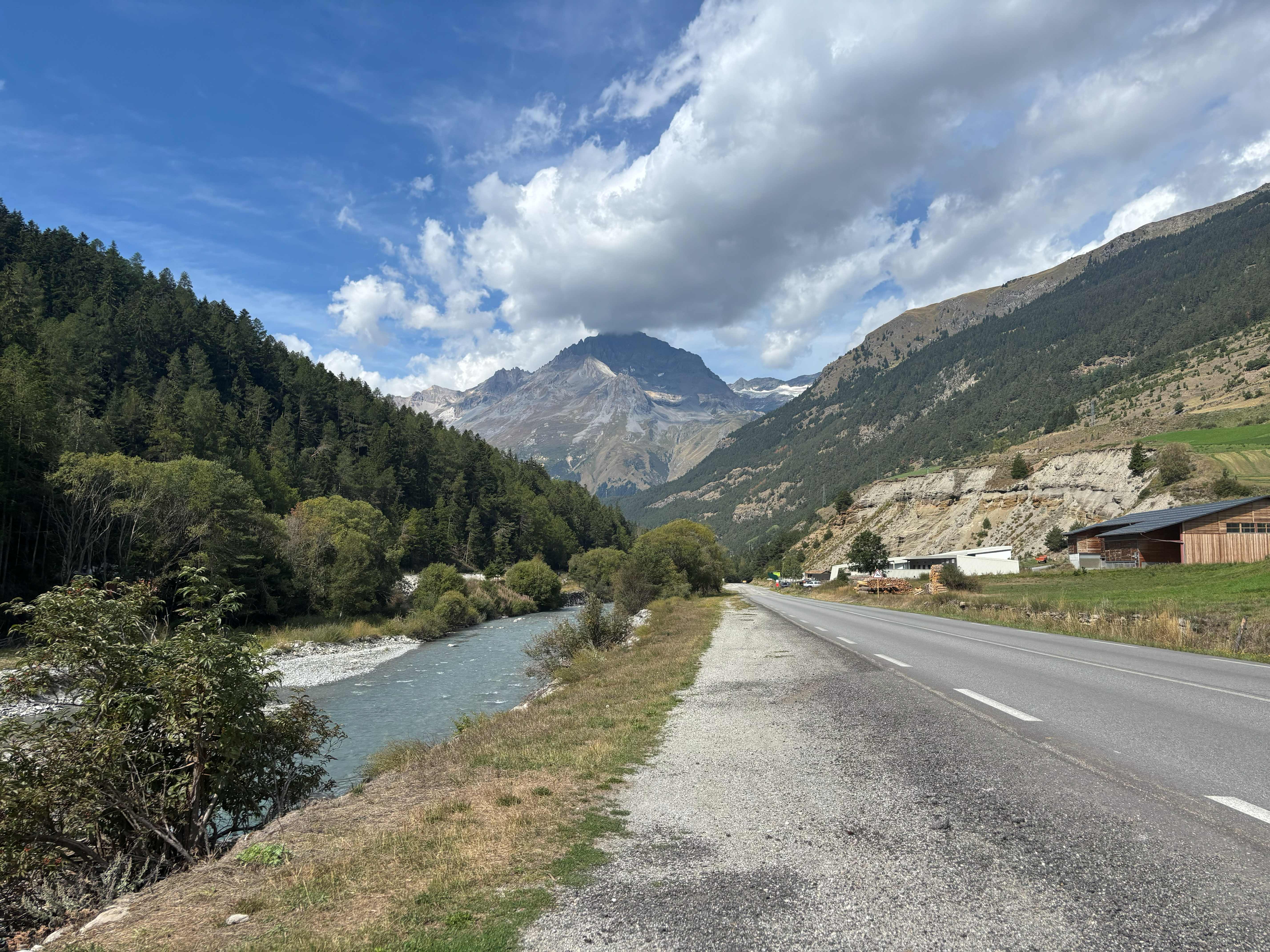
The River Arc below Lanslebourg, looking down the valley towards St Michel. All calm in 2026, but in 1866, 1920 and 2025 floods have washed away roads and railways.
The Paris, Lyons and Mediterranean Company repaired the ten miles of railway between St. Jean de Maurienne and St. Michel. The works between St. Michel and Termignon were repaired and their strength added to, by the French Government at a cost of about £80,000. The French Government also recognized the claim of the Fell Railway Company to consideration, by agreeing to repay two-thirds of the cost of reinstating its works as they were previous to the floods, so the company incurred a direct financial loss of not more than from £3,000 to £4,000. Despite this compensation the company sustained a heavy loss from not being opened to carry traffic across the pass during the spring, and summer of 1867, thus potentially losing out on around £100,000 of projected income.
By May 1868 , construction had finally finished and test trains were being run on the route. On 22 May, most of the directors arrived in Susa in the company of fifty distinguished guests including members of the press for a test run. The passengers included the Duke of Sutherland, Thomas Brassey, Edward Blount, William Buddicom, Alex Brogden and naturally John Barraclough Fell. A light buffet was held at Susa and the train comprised of four first class carriages to accommodate the distinguished guest left at around 11.30, They arrived in St Michel at 4,30 in the afternoon, where the Mont Cenis Company had organized accommodation followed by drinks and dinner at the Hotel de la Poste. The correspondent of the Daily Telegraph reported in glowing terms.
“ The virtual suppression of the Alps as an obstacle to rapid and convenient locomotion is an accomplished fact .The enormous barriers set up by Nature between France and Italy are to be surmounted from this time forth with scarcely greater difficulty than if the contiguous frontier lands of these countries were so much level land . No more diligence , stuffy in summer , draughty in winter, limb cramping and digestion-disturbing at all seasons. For the future at least , until the enormous tunnel shall be completed ,, with infinite labour and expense, -if you desire to pass from France to Piedmont, all you will have to do is to change carriages at St Michel , run swiftly up Mont Cenis until you shall have attained an altitude of nearly 7,000 feet ( 6,658 feet is the highest point actually traversed by the line( , and then run down again as rapidly as you mounted., until you reach Susa , where you will again change carriages and continue your route , without further trouble to any part of the paradisal peninsula , or to Egypt, to the Indies.”
The opening of the Fell railway was scheduled for 8 June , some further tests were required and the start of passenger operations was delayed by a week. Finally at 6.30 am on 15 June, the first commercial service left Susa station. By 1 August the service was fully integrated with the French and Italian railway networks and passengers could obtain a through ticket from Parsis to Florence, a journey which now took only 36 hours and ensured that the mail reached Florence a day earlier.
Although first few months of operation went well , the weather intervened again and further flooding and early snowfall wreaked havoc with the schedules in August and September of 1868. . Revenue was falling well below predictions and it was clear that the railway was only likely to operate at a loss. Meanwhile the tunnel progressed faster than expected as new tunnelling methods were developed and was opened on 16 October 1871, as provided for in the original concession this meant that the Mont Cenis railway was required to cease operating , which it did the day before the tunnel opened. The original revenue projections had been based on seven years of operation. In fact the railway had been open for little more than three years. Based on initial costs of £320,000 and an estimated annual revenue of £100,000 per year , it was pretty clear that three years of operation was insufficient to cover the initial investment. But it wasn’t just the weather geo-political events intruded and with war between France and Germany blocking northern France and Paris frm the route. The Germans defeated the French at Sedan , the Paris Comune had been declared and viciously put down, Napoleon III retired to Chislehurst and the estimated traffic across Mont Cenis and projected revenue streams suffered accordingly, leaving Mr Fell and the proprietors with a mounting losses.
As part of the concession, the Mont Cenis Railways Company was required to tear up the tracks , which as Brunlees had predicted could be sold elsewhere. There are few remaining traces of the Mont Cenis railway although some of the tunnels remain. The road is still there the French D1006 and when the pass is closed in winter , now forms part of Europe’s longest green ski run “The Escargot” well at least while there is still snow in that part of the world. Susa got by passed by the new Turin- Modane line through the Fréjus Tunnel and is now just a branch line from Turin. Although from an engineering point of view it was a success and worked well the Mont Cenis Railway was a financial disaster for all those involved . When the railway was dismantled the track and indeed some of the rolling stock may have ended up on Brazil’s first mountain railway Estrada de Ferro Cantagalo which operated from 1873 to 1965, and used the Fell mountain railway system,, although from 1883 the Fell rail was used for braking only. The line was built by British engineers and capital.
Both Lanslebourg and Susa suffered as a result of the opening of the Fréjus tunnel. Lanslebourg, which had made its living off the route over the mountains was almost totally bypassed, with the tunnel open there was no longer any need for the muleteers , waggoners and guides who had previously prospered there. The Turin Modane line was diverted at Bussoleno, the stop before Susa and Susa just became a branch line, for people wo wanted to go to Susa,
There may be a part three to cover the stretch from Modane to Lanslebourg, sometime. Biased on the current sales of Robertspublications, Part four “the search for the Fell Railway in Brazil”, will not be happening anytime soon.
The bus over the Mont Cenis pass has now ceased for the 2026 season. hopefully it reopens again in July 2027. meanwhile you can cycle or go by car. The pass closes between November and May. However you could ski down L'Escargot
The Relais des 2 cols is on the main strret in Lanslebourg
Set de table Relais des 2 Cols - hiver 25-26
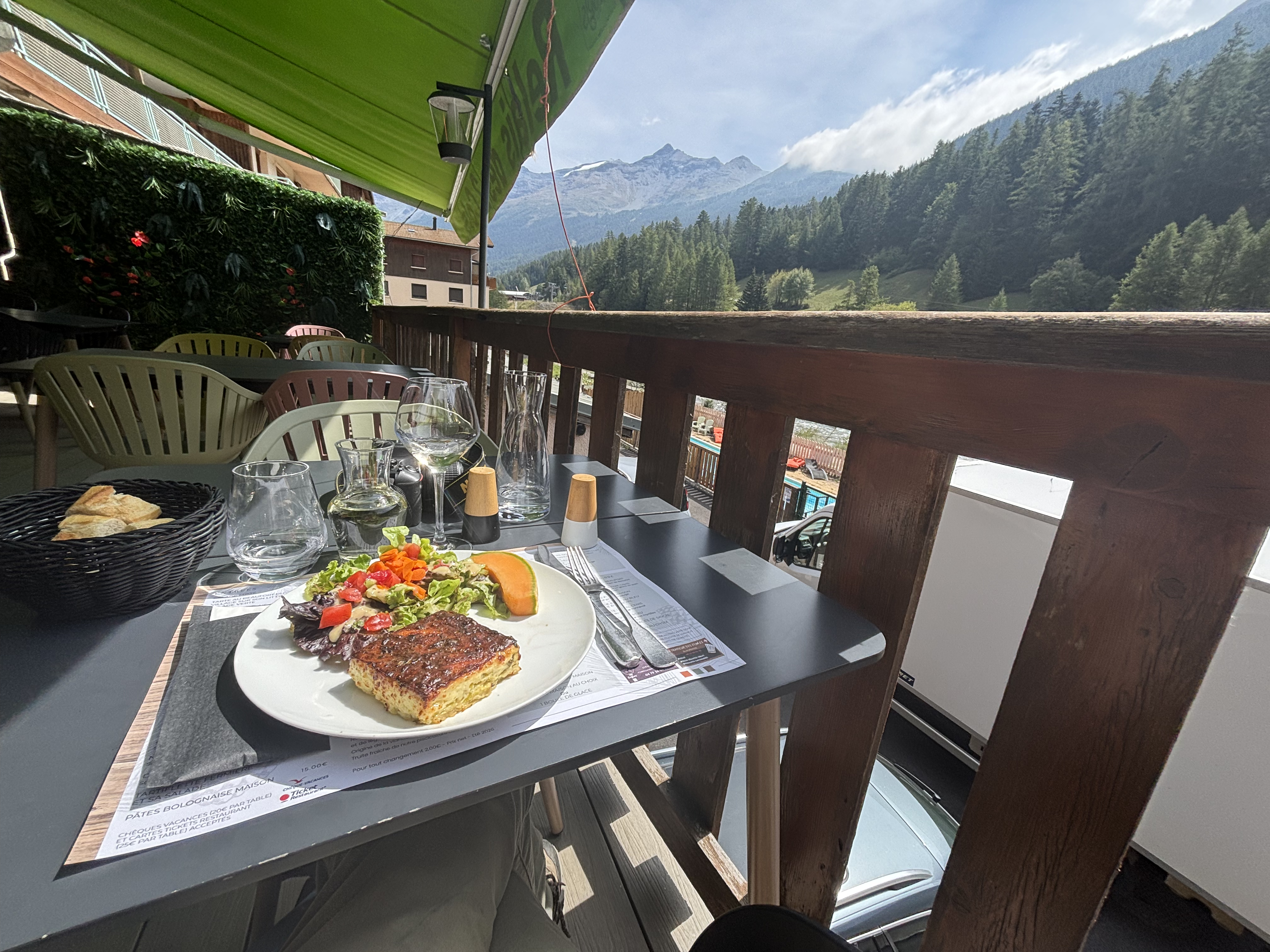
There is a frequent train service between Torino Porta Nuova and Susa