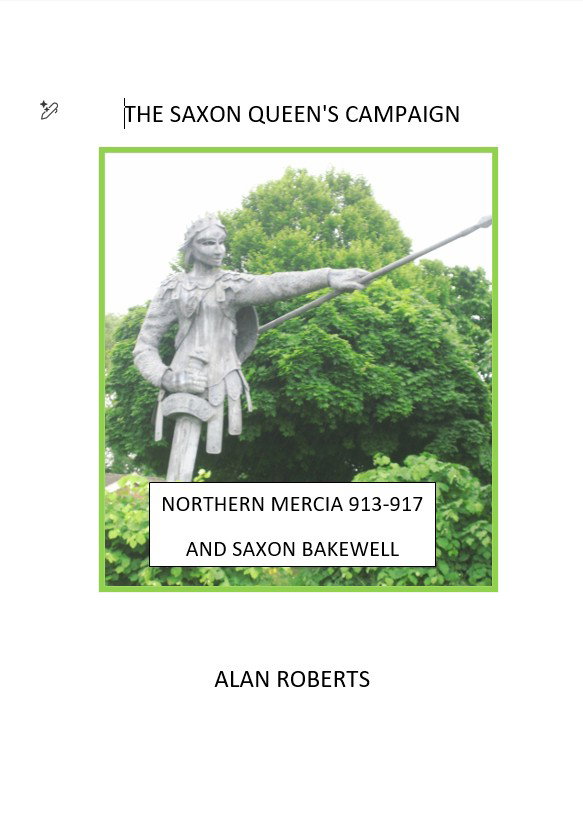
A new book from Alan Roberts "The Saxon Queen's Campaign"
Alan Roberts has written this short book on the Reconquest of Northern Mercia between 913 and 917 with particular reference to the town of Bakewell in Derbyshire. Like many people my British history knowledge starts with 1066, something to do with the former A- Level syllabus. I was aware of the Renconquista in Spain, but the slow and methodical Saxon reconquest of their invaded lands in Northern Mercia in the 10th Century was unknown to me. The “Danelaw” originated from the invasion of the Great heathen Army of Enfland in 865. After raining England from the 700s onwards, targeting monasteries, costal towns and anywhere wealth could be fund, the Vikings launched a full scale invasion of England, landing in East Anglia in 865. After several deceased of fighting, a series of settlements in North Mercia had been lost to the Saxons, including Manchester, Nottingham and Derby. With a basic knowledge of the Viking invasions, I had always associated them with York and the East of the Country, I never realised they got as far as Manchester and Derbyshire. And it was in Derbyshire, that one of the bloodiest events ever to occur in England took place. In the autumn of 873 the Great Heathen Army reached Repton near to the River Trent , establishing winter quarters there, before completing their conquest of Mercia in 874. The monks and nuns of Repton Abbey who had been peacefully watching over the remains of Mercian rulers were left with no choice but to flee, taking the remains of Saint Wigstan with them. The Great Heathen Army looted and destroyed the abbey, and built a fortified encampment in the grounds. After that the Army split into two , with one part heading south to be defeated by Alfred.
Finally with the peace agreement between Alfred and Guthrum, a modus vivendi was established, with Danish self-rule in the occupied areas, which became known as the Danelaw. However, the Saxons had not given up hope of recovering their former lands and in the early 10th Century they began a campaign to recover them. Leading the campaign was Aethelflaed, daughter of Alfred the Great and the effective ruler of North Mercia. From around 902 onwards, the North Mercians slowly and methodically began to recover their lost territories including towns such as Chester, Runcorn, Nottingham, Manchester and Derby and the town of Bakewell. In the end they reached a line on the river Mersey and a further peace settlement was agreed .
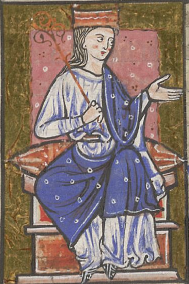
Queen Aethelflaed effective ruleer of North Mercia who led the reconquest of the area from the Vikings
In the next section of the book, Alan tracks the occurrence of place names based on “burh” in the area of the north west from the Mersey and down into Derbyshire , looking for patterns in place names and locations. Burhs were Anglo Saxon fortified settlements, originally constructed in Wessex under Alfred the Great as a defence against the Vikings . It was apparently Alfred’s original intention that no English farm should be more than 20 miles from a Burh, in which they could shelter from attack . So as the Mercians reconquered their former kingdom, it appears that they might have established a series of burhs in the Northwest to consolidate their hold on the reconquered land and provide a means of defence if the Danes launched a counter attack, Effectivey the Mercians cleared out the Danes from the reconquered areas a, reestablished their authority and finally consolidated central government authority by establishing infrastructure. These new burhs were established in a pattern, which might then provide support to each other and the population in their catchment area. Bearing in mind that being 20 miles apart, that was possibly the limit that a body of men on horseback or marching could reach quickly enough to be of use. And if that all sounds a little familiar , it reminds of what the Americans during the Vietnam war called “Strategic hamlets” . As the Americans attempted to rollback Vietcong insurgency in South Vietnam, they came up with a policy of strategic hamlets. The policy was split into three stages: Clearing, holding and winning
- In a ‘clearing’ stage, areas for settlements usually next to previously secured areas. These areas were then ‘saturated’ with forces to either repel insurgents or force them to leave for neighbouring territories, which could then also be ‘cleared’ .
- There followed a ‘holding’ stage, where government authority and security in the area were reestablished. Troops and police did not merely leave the hamlet once it had been cleared, so insurgents would not return at a late date.
- Finally,the ‘winning’ stage involved the construction of schools, irrigation systems, new canals and road repairs to give the impression that the government was working for the people’s benefit in a ‘permanent capacity’.
Having cleared and held one village, the theory was to move on to the next village. The policy did not actually work for the Americans but in 10th century England , the villages were being cleared of foreign invaders who had been in occupation for less than fifty years and the Saxon inhabitants were presumably glad to see the back of the Vikings .
Finally Alan goes on to look in detail for some signs of the Saxon influence n Bakewell and its role as an influential Saxon settlement before the reconquest of Derby,, by looking at the development of Bakewell’s street plan over the years and taking us on a journey of what might remain of Saxon Bakewell today. I was there taking photos while we strolled around Bakewell trying to identify what its Saxon Street plan might have been.
Alan puts forward an interesting idea that Aethelflaed’s campaign to reconquer Northern Mercia followed a pattern which involved the systemic clearing of the Vikings from previously Anglo Saxon settlements, holding the areas and ensuring control and then moving to adjacent areas. There appears to have been a method to the Mercians reconquest which took them several years to accomplish, but which worked at the time. And that apparently left a trace in the place names and strret plans of the reconquered towns.
As I say, it was an unknown period for me and Alan-s book raises some interesting questions and areas for further research. For a broader view of this little known period in British history, it is well worth reading Margaret C Jones Biography of Aethelflaed “ Founder, Fighter , Saxon Queen “ . Alans’s book “ The Saxon Queen’s Campaign “ can be ordered through this site or is available in bookshops in Buxton.
https://app.site123.com/store-1/the-saxon-queen-s-campaign?w=2369425